Showing posts with label 3D Printing. Show all posts

Monday, March 4, 2019

When Students Shine!

Giving students the time to create is an important learning experience. Creativity is not limited to just building or making, creativity is a process when students:
  •  Iterate and ideate to problem solve in any subject
  • Collaborate to communicate for problem-solving 
  • Develop character for leadership, perseverance by valuing all perspectives, ideas, and feedback
  • Developing self-compassion, team compassion by being active listeners, inquiring, accepting suggestions for ideation and iteration
  • Always referring to empathy, understanding the purpose with empathy to why care and how to care for learning either by designing or getting feedback and taking action 
  • An interdisciplinary process that is inclusive of all thinking skills to problem solve (language arts, math, science, arts, engineering). Religion for us too as we focused on the Ontario Catholic Graduate Expectations
  • Connecting learning to real-world problem-solving in all disciplines
For the Science inquiry on ecosystems, the students walked to Kanata Beaver Pond to collect data about the effect of housing developments on the interdependence of the marshes, water, and forest ecosystems. The students spotted a dead bird on the road and wondered how the bird was injured and how to care for injured wild birds.

I knew about the Ottawa Valley Wild Bird Care Centre @WildBirdOttawa . The students checked the Twitter feed and Facebook page to learn more about the centre. After connecting with Patty McLaughlin who works at the centre, she presented the students with the problem of injured birds and easy accessibility for food and water. The problem for Food and Water Dishes Patty became the partner for feedback throughout the process for designing to solve the problem.

The Design Thinking process began by defining the problem that was presented by the centre.  We followed the design process by Mary Cantwell   https://www.deepdesignthinking.com/


The students took ownership and agency of their learning in developing the process. Below there are two projects. The link to the Google Photo album also shares all students' projects and learning with Patty's visit to the classroom.


Link to the project 


The link of the project 

The design thinking process was empowered by students' inquiry about injured birds. This was the first design thinking process with a partnership for this year's group of Grade 7 students. I am looking forward to their own lead design process as they plan for many community connections and problem-solving for action taking.


Of course, many thinking strategies and community development have taken into effect in order for students to build their confidence to take risks and value each others thinking. Building this community takes time, this blog post refers to the process of self-regulation and social-emotional learning developments.

The students personalized the design process by:
  • Defining the problem
  • Developing the empathy map
  • Ideation by valuing all perspectives individually to finalize a team design
  • Team design meets all problems for feeding injured birds
  • An initial meeting with Patty for the first feedback after ideation and 1st prototype
  • Back to ideation and iteration for most teams
  • More ideation and iteration after designs were 3D printed
  • Students decompose the designs using Tinkercad involving team discussions on math, science and engineering
  • Presenting the design face to face with the end user
Initial online meeting for Iteration

This was an exciting and amazing process full of agency, inquiry and problem-solving. The students were dedicated to persevere and decompose algorithms.


This post is highlighting the importance of having students explore the core of creativity. Creativity is not a task! It is the core of giving the students agency, providing them the opportunity to design their thinking, learning, risk-taking, collaboration, communication, empathy and making a difference in their community.


When students lead they learn more in any situation using creative processes from writing to designing. It is about spreading uniqueness of thinking and decision making for every step during the process and for students to continue seeking growth and be emotionally engaging for learning.


No matter how complex the knowledge is, it is not to for us to regulate, it is to allow students to connect with it to make a difference with their learning.


The students solve problems that they perceive as meaningful. We need to support thinking and not to disconnect them from knowledge building, developing ideas, prototyping their learning and making connections among each others' thinking.


Learning and students' thinking has to be revisable, iterated and reflected upon to our students to be successful. So many layers that intervene with all of the learning stages that focus on thinking skills models, social-emotional reaction to learning. Learning is prototyping, thinking is prototyping by allowing students to connect, reflect, reconnect and reflect again.


When students are experiencing designing and creativity they are also experiencing the equity of learning. We continue to transfer the empathy building from the designing experiences to our daily active learning at the school and outside the school. The design process involves social-emotional development and dealing with many situations during the process.


Some reflections about iteration, leadership, and creativity.


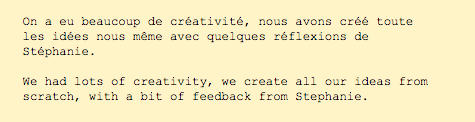
All reflections are in French. The students indicated in their reflections that the design thinking process has encouraged them to persevere in their learning and accept risk-taking. Also building empathy and compassion when collaborating and learning.

Let's make time for creativity on a daily basis by focusing on learning as prototyping and co-creating than just consuming.

How are we giving time for wondering than telling!  How do we foster creativity in the classroom? How are we allowing students to drive interest in learning?  How are students exercising or applying their agency?


“Tell me and I forget. Teach me and I remember. Involve me and I learn.” 
Benjamin Franklin (1706 – 1790)

“Too much of what is called ‘education’ is little more than an expensive isolation from reality.” 
Thomas Sowell (1930 – )


Friday, December 29, 2017

What Happens When Students Are Designers?

The year always begins with a focus on our classroom community. Trust and value within the community are important to encourage risk-taking and allow students to be engaged in the process of reiteration as Mentioned in my previous post. I try and lead a classroom without compliance where the students take a lead in their learning experiences.

I have been privileged to belong to the Digital Promise Learning Studio (DPLS) community. DPLS provided me with a 3D printer, HP notebooks, and an HP Sprout. Learning studios are equipped with powerful tools and technologies, where students use the techniques of an artist to acquire meaningful knowledge and skills that will serve them and their communities throughout their lives. It is a collaboration between Digital Promise Global, HP, and Microsoft, to reinvent the classroom as a space for learners to design, create, and invent.


The students with the Learning Studios collaborate and engage in activities and projects designed to expose them and enhance their competency in areas including:

  • Empathy and Design Thinking
  • Visual Communication and Design
  • Three Dimensional Design and Modeling
  • Digital Storytelling and Production
  • Social Entrepreneurship

The projects were designed by the students to make a difference in our community. Some students solved problems with the Humane Society and a veterinarian clinic, while others focused on autism. Most of the projects are still in the process of prototypes, using feedback from the users for improvements. The Innovation club of Grade 7 and 8 students teamed up with our retirement home community to design tools to help them with their daily needs.


For all of the projects, students collected data by interviewing both Stephanie Youngdale the Humane Society Coordinator and Dr. Ellis for the IV tool for animals and also by observing the autistic students at the school. Both groups had clients to provide feedback. The Innovation Club regularly visited the retirement home and shared many games that were designed/coded using Scratch and Micro:bit. They built a relationship to observe and design utensils for easy grip.


Please review the projects on this link. To view students' reflections and documentation, please click on the images. The designing process will continue and I will be updating the links on the blog.


The learners have reflected and documented their progress throughout the process. The design learning process focused on conversations through problem-solving. This process allowed learners to value emotions, opinions, perspectives, ideas and authentic self-learning and self-driven thinking. This learning was acquired by giving students the opportunities to empathize with a community for a community.


The learners regularly reflected on their competencies of collaboration, character, and creativity. Creating solutions for problems provided learners with the opportunities to take action of their learning by living the process of design thinking/makers thinking. While designing, learners are creating solutions and making a difference, learners:
  • continue to wonder
  • question to take risks and problem solve 
  •  invent, reinvent and learn together
  •  fail many times to learn
  • are creators of learning 
  • deal with social-emotional impacts on their learning
  • build friendship relationship, independence, social consciousness, compassion, imagination, originality, enthusiasm, passion, sincerity, trustworthiness, generosity and sincereness
How do you get every student involved in thinking and learning?

The students become involved when they embrace the system of innovation and become self-driven and self-creative. Have students create; to adjust their learning and feel the impulse of embracing innovation and creativity. As educators, we should never close our classroom doors on creative opportunities. We become a project facilitator, a collaborator and a co-creator when students are embracing full ownership of the design process. We should reflect on:

  • how are we creating opportunities for ownership of risk-taking for learning?  
  • how are we allowing students to negotiate and socially network their thinking? 
  • how are we allowing emotional problem-solving?
I will share some students' reflections as a conclusion:

"While we created our conception we were very enthusiastic about being able to help out animals with our own ideas, we encountered problems, but we persevered and finished our conception. Our hard work paid off and I am proud of what we made together. I am glad that we have these opportunities to work together and be part of a community."


"To create our ideas, my group and I created our own ideas and took one factor to build onto the other ideas. We were very creative and it showed when we interacted our conception to improve it. We iterated our project four times and every time we fixed more problems we encountered. Our experience will help us improve our critical thinking and collaboration, While also being able to improve our interpersonal work because of what others have taught me. "

"In my group, we had a lot of open-ended conversations. We discussed all the ideas we had, the pros, the cons, who will do what, who knows how to use Tinkercad, ect. In the end Austin did Tinkercad, but he didn’t know Tinkercad like other people in our group did. That’s just one example of learning how to use tools we didn’t know how to use very well. To find the final model we went through about 4-5 different ideas, each person added to one of those ideas, but they still weren't the best idea we could come up with. I heard “What if I might” or “What if we did this..” a lot. Finding the solution to all the problems took up a lot of time. Then when Stephanie came, she told us more information on what we’re doing and what she’s looking for. "

"During our working process, we worked as a group. We worked as a group while we worked documenting our process. I think my group developed good, thought out ideas because we all know each other well and know that the other people won't judge our ideas. "

"We collaborated efficiently and constantly to create a solution that will help animals. Our solution is a 3D printed model that follow the criteria while enabling us to add our own creative ideas. Our conception has evolved into more advanced designs. We began with a ring with hooks to attach onto the bars, the lip of the bowl would be held up by the ring. My group and I thought of some possible problems though, one of the problems were the size of the bowl, some of them would be too small and would be able for the ring to hold it up and others may be too big and wouldn’t fit. After considerations we decided on making a bowl with hooks instead, then there wouldn’t be a problem with the size of the bowl. "

"I think I’m in accelerating because my group and I were extremely determined to finish the task. We all gave feedback to each other's ideas we had, for example: My first idea to print two connectors, they would snap together. One wound be on the inside and the other on the outside. The bowl would rest in an outline of a circle which is also connected to one of the pieces that snap together, then, you just snap it together and it stays in place. When I presented my idea to the group, I got feedback, good and bad. I got one saying that it would work, I got another saying that it wouldn’t fit because we don’t know the measurements of the bar. My team preserved well because like I said, we gave back feedback and we discussed the pros and cons. "


Wednesday, March 16, 2016

Designing With An Impact!

This blog focuses on promoting students voices and actions not only in the classroom as well as in their community.  Patricia Fiorino and I have a 3D printer through Teacher Learning and Leadership Program. The Grade 6 and the kindergarten students  have worked on projects together,  The 3D printing experience has been extended for Grade 6 students by applying their problem solving, collaboration  and creativity skills to passion projects.

To encourage the students' interactions through the school community, early in the year I approached our school resource teacher if the students could design and 3D print  objects that could be useful for the school's special needs students. The problems were presented to the Grade 6 students to design and use the 3D printer for passion projects not only for solving problems, also for serving the community.

The following videos represent the process from iteration of prototyping to the end users.

            The passion project for sequencing blocks.


The passion project for Math skills:

Video 1


Video 2


This link is A screencastify of Joshua explaining the changes on the numbers

Through this process of designing the students learned:
  • To value each others ideas 
  • To rely on each other to problem solve
  • To initiate and take matter themselves by coaching each other
  • To iterate many prototypes through feedback of end user
  • To take control in their own hands
  • To 3D design by monitoring area, ratio, volume, dimensions, coordinates on the plane and determining their next steps
  • To find solutions for the school community (more projects still to be completed)
  • To impact others in their community through a process of solving complex problems and that designing is full of iteration
  • To impact others by their innovations
  • To use the instruments of ideas and technology for a passion
  • To commit to a process of creating and orchestrating solutions in a large group task
  • To get feedback and insight from the users on next steps
  • To initiate innovation of intimacy of consuming time with users and unpacking what works and doesn't work
  • To engineer and think together as a process of research that is lead by them, a shift that is usually lead by adults
  • To accept diversity of thinking and abilities for designing 
  • To bring skills together from technology to multidisciplinary by building tensions of thinking 
  • To experience a process with many intensities for sharing ideas and challenges by getting great insights and solutions in a controlled chaos!

The students always empower me with their creativity,  perseverance and their drive to innovation.  Their drive and diverse thinking brought skills together from collaboration, creativity, critical thinking and communication with energy and motivation to create. The main concept that the students acquired through this ownership of designing process, is that designing is the iteration from technology to multidisciplinary thinking tensions that creates great insights for creative solutions.

The students independently became equipped with a way of problem solving and continuous exploration with the passion of iteration for success. They mapped their own challenges!
.
As educators how are we giving students experiences to connect and understand how to use their talent in serving their community?