Showing posts with label Thinking. Show all posts

Sunday, June 5, 2016

What Really Matters!

The power of learning is connecting students to the real world and making every day learning realistic through problem solving.  The students need to become analytical and connect cross- disciplinary thinking to the real world based on political events, news makers to the arts and technology innovations. The key to the success is for the students to be initiated in discussions that would require gathering information, analyzing, interpreting and exploring possibilities.                             


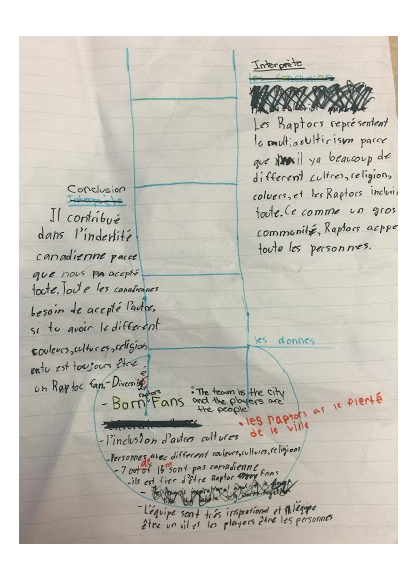
In order for students to enrich their experiences about The Grade 6 Social Studies on Heritage and Identity, they collected data to assess contributions made by various groups to Canadian communities. The students applied the model of The Ladder of Inference ( I-Think Rotman School) for the mental process to collect data about Canadian identity, inclusiveness and multiculturalism. The data we collected were from three different sources, the retirement home open ended interviews with the residents, the CBC report about the Raptors and students own open ended interviews from their own community.


The students examined the data based on experiences and observations in the world around us. It was a very huge data especially from the retirement home. In teams students selected and interpreted based on their experiences and understanding. The interpretations lead to conclusions that became our bases for our understanding of inclusiveness and Canadian identity.


The following presentation has students’ samples from the visit to the retirement home and their interpretations from the collected data.


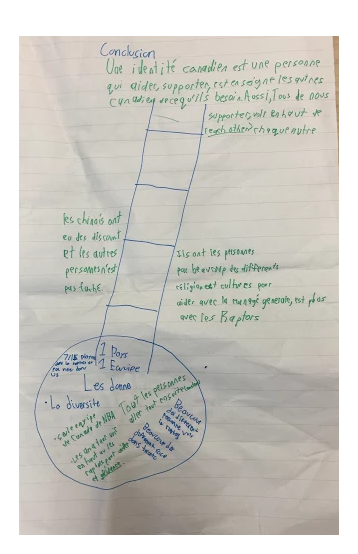
To continue with our understanding on multiculturalism I shared with the students  the CBC Report about the Raptors and multiculturalism.  The students collected the data from the video and interpreted it.
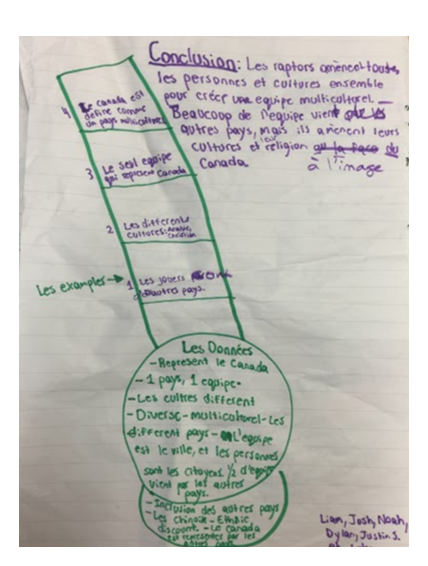


The students continued exploring with multiculturalism and inclusiveness by interviewing their parents, neighbours and people from their community. The following slides include examples based on the question:  Has Canada attained its goal of inclusiveness?  


The students' discussions were rich from historical facts to the present about inclusiveness that provoked many inquiries about the aboriginal treatment to the refugees and racism in today's society.


The students searched the The Canadian Encyclopedia  and inquired about the history and the presence of many cultures, the reasons for their arrival to Canada and their integration in our today’s society.


In order for the students to gather all the thinking for better understanding of many elements in the Canadian identity, we then focused on the causes and effects. From gathering so much data and inquiries about the past and the present and making their thinking more explicit and giving the opportunity for teams to share their thinking as they have explored many complex issues on inclusiveness, identity and multiculturalism. The students (in teams) shared their understanding about Canadian identity by developing a causal model ( I-Think Rotman School).


The students explored my maps to house their inquiry and thinking process on diversity, inclusion and multiculturalism. I will only share an example of the map. The students screencastified the causal models explaining their thinking. Please scroll through the layers of the maps to view the ladder of inference including the Causal Model and the videos. A screencastify of a student explaining the causal model 1  Screencastify of the causal model #2


There is so much to share and I need to improve on blogging often instead of sharing the full process with just the one post.


Through the Integrative Thinking the students have experienced effective collaboration to learn to leverage each other’s ideas by being deep flexible thinkers and problem solvers. This process from data collection to gathering thinking of causes and effects has given the students tools to challenge their thinking and deepen their learning. The complexity has become explicit based on their interpretation and allowing opportunities to expand their learning.


As educators we have to always think, how are we equipping our students to become effective collaborators with strategies to think and problem solve?


Tuesday, February 3, 2015

A Collage Of Learning!

Learning is a day of collage!  We always hear learning is messy what about an interactive messy collage of innovators with many ideas!

Earlier in the year I captured the learning by vlogging about our day and producing videos of the learning process. I get carried away now with students' process and giving feedback that I forget to capture the learning. 

 This post focuses on. how does learning roll out and how do students make learning last?

We start our day by looking at the daily reflections from the students eportfolios. Yesterday one of the students reflected on the step by step of how to create a photo slide show on youtube. Her reflection became the criteria of the day for the students who are using youtube to create a photo slide of the functions of the human systems.  The students also had a great question that we will pursue tomorrow. 


Students following Angelika's reflection as a criteria for creating the photo slide at completing the Gr5 Science about the human body.


 Some students are persevering with the art of an organ from the system and building a model of the system with plasticine.


Liam is preparing the prop for the drama to explain the urinary system.


I even captured a video of it!


Learning is always fun and lasting and there are always ways to have students invest in their activities.

How can we always create an interactive environment of connecting students experiences? How can we always grab student's' heart and minds for learning?  What will the collage of learning be like tomorrow?

Sunday, December 14, 2014

Coding For Success!

Anyone can do it and anybody can be successful at it!

Coding is creativity, collaboration, critical thinking and communication, it is valuable with interpersonal skills. I introduced coding on the first week of December to my students. I provoked the students' thinking by having each team link to an animation and play while seeing the inside. Students immediately figured out the how of coding. We began co-constructing a criteria and identifying the variety of coding for the script. On the classroom site I shared many coding articles informing parents about the importance of computing language. Once students knew about http://code.org/learn that same evening students were completing the Hour of Code certificate and exploring game designing and sharing them online on the classroom Padlet for coding.

In class immediate collaboration began, guiding each other through the how of coding and sharing new discoveries. Once the coding skills were established, it took students two days to become familiar with the computing language. Students began a project showing their learning about  Social Studies curriculum describing the causes and effects of interactions between European and First Nation for Grade 5 and for Grade 6 Canadian identity by various groups historical and contemporary communities.

Why was coding very successful?
  • Peer programming, thinking together 
  • Perseverance, resilience and persistence 
  • Self- Confidence
  • Problem solving
  • Sharing thinking 
  • Application of new knowledge
  • Peer collaborating to improve results
  • Explaining their reasoning
  • Analyzing 
  • Application of feedback
  • Reflecting and improving their learning process
  • Identifying and assessing ideas for creative application
  • Deep discussions and decisions ensuring team strengths
  • Collective responsibility for individual expertise 
  • Expression of point of view allowing teams to move forward
  • Encouraging each others' innovation
Essential skills were highlighted and practiced. Students were getting further ahead by restarting and rediscovering learning by overcoming any setbacks. They were problem solving and caring for each other.

I was activating and giving students the chance to build their self-confidence at learning and I was observing and asking students as they code about the how and what if of coding language. The engagement blossomed and shined and students became tech leaders at improving their thinking, It was a mindset of  learners and creators by unpacking a canvas of many skills.


Through Our Learning Connections Fair my colleagues Patricia Fiorino who teaches Kindergarten and Natalie MacDonald who teaches Grade one also spoke about Kodable, Daisy Dinosaur and Scratch Junior. I am sharing the Scratch presentation that has links to the padlets for both classes and also students' reflections and explaining the coding. A group of students also created a site and an Incorporation  for others to try their games and leave feedback.  During the Hour Of Code week my students guided the Grade ones through an online coding Scratch animations.


Please share your learning from your students when they start coding and unpacking skills.  How successful will your students be at coding?


Sunday, November 30, 2014

Are Learning Communities effective?

An overdue post since superb conferences like GAFE and  BIT14 as well as amazing learning opportunities from our board the New Pedagogies for Deep Learning (NPDL) to the Learning Connection core team and our planning for December 10th face to face sharing with many colleagues from across the board.

Those three weeks in November have impacted my learning by curating more to my thinking. These thinking skills have confirmed and encouraged to deepen my practice with colleagues and my students.

On Saturday morning on twitter I came across this very pertinent tweet:


So true, without collaboration our growth is limited! These learning opportunities are always a result of collaborating face to face with colleagues. They have been a vaccination of thinking opportunities that jolts us to persevere and persist in our adventure with our students.

On Friday, being part of Learning Connection team and unpacking the 6 C`s  by Michael Fullan New Pedagogies for Deep Learning with my colleagues, tasks focused on the competencies of deep learning, These collaborative thinking tasks got the best out of us by developing a culture of collaborative thinking just like we are expected in our classroom.

The focus is always on the process of thinking skills not just the tools. We further explored concepts of tools, ideas on getting started and ideas for the classroom.  This culture of  collaborative learning takes determination, a culture of `yes`to collaboration, powerful pedagogical influences and seeking support with each other and empowering us to connect these pathways to our students.

As we expect from us to be learning partners with our students the same takes place at these meetings. Karen allows us to be in partnership in learning from and with each other as she permits for team collaboration of unpacking the thinking skills as she also becomes a learner with and from us.

These cultures of learning opportunities are permissions provided for us to allow us to take risks with our learning giving and taking back to our colleagues at school as well as our students where the transformational learning takes place.

As learning leaders where are we on these daily leadership journeys? How are we being grateful to collaborate and share our learning?
My learning is surely influenced on a daily basis from my colleagues at school, at the board office and colleagues from all school boards in Ottawa, Ontario and my large learning staff room twitter.

We need to always keep a positive learning perseverance, take those risks and keep connected for more learning practices and accept that learning is messy!

What new learning will I be trying with my students? I guess I need to keep publishing more of my posts rather than keeping them in draft. I should spend more time sharing the risk taking process of learning with my students.


Sunday, November 2, 2014

Google Drawing And Documenting Learning

We have used many tools for capturing the thinking process and documenting our learning, from Audio Boom , explain everything and other IOS apps as well as GAPPS. In this post, I chose to share documentation of learning through Google Drawing. The students have been applying Google Drawing for explaining their thinking and learning since September. The students document their learning process by uploading it on the eportofolios. We have used Google Drawing with Keizena, attaching a link for the criteria on the drawing, checking for comprehension of a text, and screencasting for evidence of applying feedback.

Google drawing with Keizena: Many layers of sharing and documenting.

1- By commenting, this student explained her favorite photo taken during the Terry Fox walk in September at Kanata's Beaver Pond.


2- The student added a link to the same image, explaining her 2 other photos about the Beaver Pond in relation to the same image. At the top of this image the student's initials LC and next the link. 


3-The link leads to  the Google Drawing that explains what is in common of the 3 photos.


4- Students also added their voices to the Google drawing and teacher's  feedback was also recorded.


Google Drawing and success criteria attached on the Drawing. 


A student explained First Nation People adaptation to the environment. When the title (Les Algonquins) is clicked  the  document of the success criteria that is attached will be viewed for feedback.  The students made a copy of the original document of the criteria, shared and attached it to the drawing.


Google Drawing and assessment for reading comprehension


The students  either labeled the events or ordered the boxes after reading a text for a comprehension self assessment. 


We were very fortunate to have the WW1 supply Line Kit from the War Museum. The students created a Google Drawing explaining their feelings about the war by using the strategy CSI ( Color, Symbol and image). One of our focuses was to improve the French grammar, after feedback from the teacher, the students recorded the evidence of the feedback by using the extension screencastify or snagit.


The following video was uploaded on student's YouTube account:


Another video explaining how feedback was applied was uploaded on my YouTube account using my laptop as some students had difficulties connecting on the Chromebook with the extension.


Students connected  many skills when applying technology for documenting learning: 
  •  Responsibility and ownership of learning for providing evidence of the co-constructed criteria of tasks and learning goals, 
  •  The responsibility of planing, monitoring, assessing by peer, teacher and self-assessment,  promoting students' control of their own learning by being mindful, intentional and self-directed. 
  • Relating skills to self -regulation of the metacognitive process by promoting problem solving, trying and retrying,  applying many strategies, clarification of expectations, reflective questioning for their own perspective of designing learning. 
  • Collaboration for sharing, articulating their own learning .
  • Organization plays a big part of this process as students document their learning and upload to their eportfolios.
We will continue building skills focusing on the learning process with many tools for metacognitive purpose and making learning visible by the students for their classmates, their parents and for a global audience. Some self-reflective questioning that guides me while planning are:
  • Were the expectations clear?
  • Did I set a positive environment of trying and retrying by consolidating with my students?
  • Did I provide the time for learners questioning about the process?
  • Did I ensure learners were motivated? (Provocation so important)
  • Did I provide the resources for scaffolding and feedback?

Sunday, September 28, 2014

We should never assume what students know!

Our school received the Giant map of 1812 from the Canadian Geography. These giant maps are perfect for students' inquiries on Canadian History, Geography and Science. If you have not ordered one visit The Canadian Geographic Site for the Giant floor Maps

Provoking (Previous post) is the most important step for inquiry especially relating to the current Canadian and world issues. The Franklin Expedition was on the news and we began our discussion on why is it important for Canada to spend money retrieving the expedition? Why did Stephen Harper show an interest in visiting the site?

I was presenting the social studies curriculum to the Gr 5/6 students to start our inquiry about the Canadian History and Geography. I told my students that history is all about asking questions.
I thought I would ask the first question what is History and Geography? It was so interesting to find out students' reaction in teams and brainstorming of the two concepts. History was a little easier as they had some knowledge and no idea about Geography!

Hold on! Before I proceed with the war of 1812 and unpacking the overall expectations of the Social Studies Curriculum., An unexpected great discussion was necessary that I assumed students knew!

I gave students time to explore posters from the Legion about Canadian participation in wars. I had just participated in the Army Run and shared my shirt that showed celebrating
100 years of WWI.  We revisited  the graph on what they knew about History and Geography and so many more ideas were provoked and added.


By analyzing the meaning of history and geography and taking time at exploring these general concepts students have developed a meaning and interest at not only looking at the passed, also at reasons for our existence of where we are and provoked discussions and interest in exploring so much more of the changes, effects and how do we know what we know?

An unplanned discussion by listening to students is important. The extra time spent on this discussion engaged students' focus and perception of presumably simple knowledge to excitement and inquiry through the the curriculum that they will start this week. 

The map also provoked an understanding of historical events prior to 1812 for the G5 curriculum and historical Canadian identity and contributions for the Gr6.

It was a powerful, unexpected progression in which the students became completely aware about the reasons and impact of history and geography. I do not regret taking that extra time as it merged them into a meta-inquiry of why we learn history and geography. 

This made think do we always have to rush through the planned activity?  Do we have to rush from activity to activity? 

A short video of the Gr 5 historians and geographers on the map of 181.


The Padlet for provoking historical and geographical events. 


Sunday, July 27, 2014

More Than Interactive Cardboard Boxes!

What do you get when you give students a chance to explore their own curiosity, plan for fundraising to make a change and science tinkering with electricity! Interactive arcade cardboard boxes for the whole school to participate and play for making a change.

I have shared a blog post about the curiosity blocks where students lead their own curiosities. Being involved with Free The Children, students decided to create arcade games during curiosity blocks and fund raise for building schools. Blog about Curiosity

This blog post  http://prendreactions.blogspot.ca/   by the Gr 6 students documents and explains all initiatives that they have organized For Free The Children. The students were also featured on Free The Children Blog about their creative fund raising. St-Gabriel-plays-change Free The Children

Students have already created the arcade games for the First Initiative for Play For Change . As a class we decided to keep the arcade boxes and turn them interactive to apply electricity (Science curriculum for Gr 6 students). We started with the fundamentals by exploring through several tasks at discovering what is static electricity and how is it applied in everyday life? What are circuits and how do switches activate circuits? What are the different kinds of switches? The overall expectations of the curriculum were unpacked by the students. Please see previous posts from this and last year explaining how students unpack the curriculum and set their learning. 

Students take ownership of learning when they are creating and producing. Through making students seize control of their thinking especially when they are reflecting during the process on what they have learned and how they have accomplished their creations. Classroom Blog on Electricity by Gr 6 students


As teachers we have to keep in mind that the work should be done by the students. We need to give students the chance to have a voice and control of their thinking, share learning, create, fail and learn from each other. These Interactions are about the assessment and the reflections that are part of the inquiry and thinking process. Through making, collaboration, problem solving and the sense of wondering are ignited which it reinforces skills to solve real problems.


This Padlet has some examples of students' creation on electricity:


Propelling Curiosity!

 It is important to provoke students' learning for curriculum inquiries in many exciting and innovative ways. It could be artifacts, videos, current event news, objects, interviews, wordles, pictures and even from a story book.  As teachers we always have to bring reality into the the inquiry process to connect real life experiences into everyday learning.

There are multiple ways of  propelling curriculum curiosity in class and inviting students to spark and ignite in questions that they never seem wanting to stop learning, sharing and collaborating that conversations become an ongoing vehicle of exploring and developing ownership of learning.  It is so exciting to see students push each others thinking and learning by questioning, seeking, pursuing, confirming, convincing, comparing their ongoing development of thinking and reflecting in depth on their learning.

Of course along the way students co-construct criteria not only for the purpose of reading, writing and speaking, also for the learning skills. These foci of strategies that overlap and extend thinking as well as learning skills (responsibility, self-regulation, collaboration, independence, organization and initiative) that loop and promote metacognition and reflection on learning. Reflecting (at the end and the beginning of the day) on learning, is what drives our thinking throughout the process and determines next steps and learning goals. It is explained in this post on Metacognitive Discussions.

The focus of this post, is to share some examples that created opportunities for thinking and provoking curiosity leading students in ownership of learning.  During this process, I become a mentor, a listener, an observer and an activator while students developed their curiosities. Students' questions always lead the inquiry process. Provoking focuses on students' questions, which is a very important step in letting them engage and take leadership and ownership of the process. The process is carried on with categorizing of the the questions then comparing them to the overall expectations of the curriculum.

These questions are a routine in activating conversations:

1- What do think is going on? Background knowledge
2- What makes you think this? Students support background knowledge and share the how and the why of their knowledge before searching to confirm and proceed to new learning. It is very import to give students this opportunity of building on each other's background knowledge and engage in conversations to pursue thinking and inquiries.  I love this stage as it solidifies their dependence of learning from each other then it provokes more thinking and further questioning actions and new inquiries through discussions. This is a very important step to takeby encourage listening, speaking and respecting other opinions and knowledge for further clarification of concepts.
 3- What would you wonder about? (After their discussions). What new learning are you wondering about? Throughout the year students develop searching skills, annotation for reading and choose ways to share new learning.

It takes time to immerse students in skills by providing exciting learning opportunities.We spend time building skills at the beginning of the year which become the core for our success and reflecting on these actions during the process to improve accountability.

There is so Much to share I will post some and every year I keep focusing on getting better at capturing the process through blogging. Some of the process captured on the Classroom Blog by the students  We focus on French daily that typing the process in English lags a little.

I seek the subject related examples off the news and social media.  Some examples of Science and Social Studies for provoking curriculum inquiries:


Science


Gr 6 


Ottawa's Great Forest  Before our walk to Beaver Pond

newfoundland-labrador/seal-product-ban-upheld-on-ethical-grounds-

canada/north/northerners-slam-wto-seal-products-decision-

Social Studies:
Gr 6
infographics-on-nelson-mandela  classroom Blog post about Mandela

snowden-docs-show-u-s-spied-during-G20-in-toronto-

it-wouldn-t-be-b-c-without-em-harper-jokes-about-vancouver-protesters

http://www.statsilk.com/maps/world-stats-open-data

If the-world-of-100 villages

-ottawa-canadiens-sotchi-mise-en-garde.

Nestle 'to act over child labour in cocoa industry' For Gr 5 on refugee and citizenship

Indian's exploited child cotton workers For Gr 5 on refugee and citizenship

etats-unis-malala-yousafzai-inspire- Gr 6 & 5


Gr 5
-confederation-line Ottawa’s world-class light rail

Justin-trudeau-removes-senators-from-liberal-caucus-

Comment organiser une cérémonie de citoyenneté


An example of students contribution after deconstructing the curriculum expectations:


Provoking learning does matter for curriculum inquiries. Students become so engaged with daily issues that themselves will continue searching and sharing realistic examples in everyday life experiences. What will you do to provoke your students curiosity this coming year? 

Sunday, June 1, 2014

Metacognitive discussions on determining learning goals!


I am sharing the process of metacognitive learning by determining individual learning goals and classroom learning goals.  This process is the base of a valuable connective platform of reflective conversational classroom community encouraging thinking, communication in learning and being clear about what students have accomplished and what needs to be accomplished.

On a daily basis students are given opportunities to engage in reflections in their learning and determining their next steps. The individual goals are shared with their teams, this collaborative thinking promotes questioning, ownership of learning, clarification of any content misconceptions and students converse about their goal setting of inquiry learning and next steps. This process makes learning transparent and it solidifies the classroom as a learning culture based on what individuals have learned and will reach. 

Using one chrome book per team students share their daily documented learning on Google Calenders that is embedded in their sites. As mentioned in previous posts Google is our Learning Platform for all activities. 

This connection also takes place face to face and digitally by inviting their colleagues to reply on next steps during learning tasks. They embrace each others' learning by having students voice on how to meet goals and share learning skills and strategies.  This creates a nurturing social, transparent and intellectual culture of learners committed by caring about each other's learning. 

The following are samples of connective learning:

Teams gather to listen, react and learn about reflective learning goals. 


Student on site sharing her reflective learning.


Students' reflections on Google Calender


We have le "professeur du jour" determining our whole group goals.


Not all reflections are digital some students to choose to write them on a daily basis 


I wished I had Google glasses as I always miss capturing many rich students ownership moment. I might invest in a pair this summer! 

All this learning is also articulated in French not only they are reflecting on their learning that is written in French also enriching their oral French through conversations. Students take risks in a second language and respect all entry levels of learning. Through this process as parents and students admit not only they have learned skills, strategies and content from each other, it has also improved their oral and written French. Through rich conversations on goal setting students take full ownership of learning during their tasks.  I will soon be posting more examples of oral rich conversations learning tasks. 

 We need to provide students with these reflective opportunities online, in writing and  face to face to constantly expose perspective of learning through an engaging community.