Showing posts with label Competencies. Show all posts

Sunday, February 17, 2019

Changing The Narrative Together!


Every academic year is different as students lead their learning and use their emotional journey through everyday learning experiences. Each year, I have to shift my pedagogical practice to build a respectful, collaborative, risk-taking, caring, compassionate and empathetic community. In my previous years, I have blogged about unpacking of the Unlearning to create a community that values perspectives for knowledge building and action taking.


This is my second year in Grade 7. I continue to explore the adolescent social-emotional learning of autonomy and agency of their learning. Their learning is being impacted by using creative tasks, focusing on why learning matters and what is next. The narrative of pedagogical practices shifts as I learn from the student’s needs, their reflections and how they learn.


We began exploring what thinking errors and biases we bring during collaboration. The team's collaboration requires trusting to share intrapersonal ideas, valuing all others interpersonal ideas to build knowledge, inquire, analyze, research and build connections for next steps.  Through the metacognitive process, we built a community of trust, risk-taking, valuing all perspectives, persevering with curiosity to guide students interest and care for their learning.


The year unfolded as students reflected about their thinking errors and biases that prevented them from collaborating and valuing each others thinking. We focused on perspectives and trusting themselves to share without worrying about being judged. We also focused on contributing with respect as well as respecting others.


We needed to:
  • Be active listeners
  • Be collaborators with a growth mindset
  • Develop communication skills
  • Have positive attitudes
  • Be reflective learners
  • Be receptive to feedback
  • Understand how we learn
  • Determine learning strategies
  • Believe in making a difference

On a daily basis, we collected thinking errors on sticky notes focusing on how their emotional learning to collaborate and accept feedback from others was affected. Through the ladder of inference (Rotman I-Think), the students were able to interpret their data and come up to a conclusion for their next steps.


From September to November we had many documentations and reflections. The students also had the first conversation with me that was recorded and shared with parents about their process of learning skills and how they have improved and their next steps.


Throughout the process, we began focusing on self-regulation and self-management of learning. The focus was on finding strategies about the learning process and environmental strategies to guide autonomy and agency on self-regulation and self-management.  During a professional development day, our principal Mr. Sean Kelly shared the Understanding Learning Disabilities From York Region District School Board. The flow chart became an essential guide for my students to reflect on their learning and their next steps on individual perspectives about their learning process. The students developed their individual plans by collecting data, reflecting on self-regulation and the self-management of learning success.


More reflections about individual learning strategies:


It has been an amazing journey of reflecting and learning about competencies, learning strategies and building a respective and compassionate community towards learning and caring about each other. I will share more reflections about students' transformation of learning:


The process of a compassionate interdependent classroom takes time to have students collect data and reflect on how and why they are learning. With my scheduling, I am fortunate to be able to make time for reflections with the students to determine the next steps. We already had three documented individual meetings about success and how they have been achieved and their next steps. We continue to develop on, who am I and how I learn? The students will be learning about the brain and its functions and how the prefrontal cortex continues to develop especially with peer pressure.

I have so much more to explore and learn with my students on social-emotional development. We have success by using thinking models that embrace risk-taking and competencies as well as design thinking tasks that focus on problem-solving and empathy.

Pedagogical practices are always shifting and meeting students needs with the focus on emotional and intellectual practices. It is important to take time and have students take the responsibility to collect data and reflect on their learning process and how it is affecting their actions towards intellectual and social growth.

How are we building capacity for learning? How are we changing our narrative of pedagogical practices with our students?
  • Reflecting on biases and assumptions
  • Are students aware of their emotional learning?
  • Are they reflecting on self-regulation?
  • Are they finding tools to guide their learning strategies?
  • Are students being active communicators and listeners?


Friday, December 29, 2017

What Happens When Students Are Designers?

The year always begins with a focus on our classroom community. Trust and value within the community are important to encourage risk-taking and allow students to be engaged in the process of reiteration as Mentioned in my previous post. I try and lead a classroom without compliance where the students take a lead in their learning experiences.

I have been privileged to belong to the Digital Promise Learning Studio (DPLS) community. DPLS provided me with a 3D printer, HP notebooks, and an HP Sprout. Learning studios are equipped with powerful tools and technologies, where students use the techniques of an artist to acquire meaningful knowledge and skills that will serve them and their communities throughout their lives. It is a collaboration between Digital Promise Global, HP, and Microsoft, to reinvent the classroom as a space for learners to design, create, and invent.


The students with the Learning Studios collaborate and engage in activities and projects designed to expose them and enhance their competency in areas including:

  • Empathy and Design Thinking
  • Visual Communication and Design
  • Three Dimensional Design and Modeling
  • Digital Storytelling and Production
  • Social Entrepreneurship

The projects were designed by the students to make a difference in our community. Some students solved problems with the Humane Society and a veterinarian clinic, while others focused on autism. Most of the projects are still in the process of prototypes, using feedback from the users for improvements. The Innovation club of Grade 7 and 8 students teamed up with our retirement home community to design tools to help them with their daily needs.


For all of the projects, students collected data by interviewing both Stephanie Youngdale the Humane Society Coordinator and Dr. Ellis for the IV tool for animals and also by observing the autistic students at the school. Both groups had clients to provide feedback. The Innovation Club regularly visited the retirement home and shared many games that were designed/coded using Scratch and Micro:bit. They built a relationship to observe and design utensils for easy grip.


Please review the projects on this link. To view students' reflections and documentation, please click on the images. The designing process will continue and I will be updating the links on the blog.


The learners have reflected and documented their progress throughout the process. The design learning process focused on conversations through problem-solving. This process allowed learners to value emotions, opinions, perspectives, ideas and authentic self-learning and self-driven thinking. This learning was acquired by giving students the opportunities to empathize with a community for a community.


The learners regularly reflected on their competencies of collaboration, character, and creativity. Creating solutions for problems provided learners with the opportunities to take action of their learning by living the process of design thinking/makers thinking. While designing, learners are creating solutions and making a difference, learners:
  • continue to wonder
  • question to take risks and problem solve 
  •  invent, reinvent and learn together
  •  fail many times to learn
  • are creators of learning 
  • deal with social-emotional impacts on their learning
  • build friendship relationship, independence, social consciousness, compassion, imagination, originality, enthusiasm, passion, sincerity, trustworthiness, generosity and sincereness
How do you get every student involved in thinking and learning?

The students become involved when they embrace the system of innovation and become self-driven and self-creative. Have students create; to adjust their learning and feel the impulse of embracing innovation and creativity. As educators, we should never close our classroom doors on creative opportunities. We become a project facilitator, a collaborator and a co-creator when students are embracing full ownership of the design process. We should reflect on:

  • how are we creating opportunities for ownership of risk-taking for learning?  
  • how are we allowing students to negotiate and socially network their thinking? 
  • how are we allowing emotional problem-solving?
I will share some students' reflections as a conclusion:

"While we created our conception we were very enthusiastic about being able to help out animals with our own ideas, we encountered problems, but we persevered and finished our conception. Our hard work paid off and I am proud of what we made together. I am glad that we have these opportunities to work together and be part of a community."


"To create our ideas, my group and I created our own ideas and took one factor to build onto the other ideas. We were very creative and it showed when we interacted our conception to improve it. We iterated our project four times and every time we fixed more problems we encountered. Our experience will help us improve our critical thinking and collaboration, While also being able to improve our interpersonal work because of what others have taught me. "

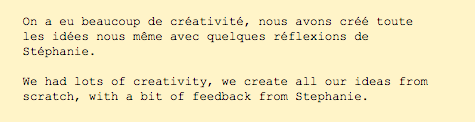
"In my group, we had a lot of open-ended conversations. We discussed all the ideas we had, the pros, the cons, who will do what, who knows how to use Tinkercad, ect. In the end Austin did Tinkercad, but he didn’t know Tinkercad like other people in our group did. That’s just one example of learning how to use tools we didn’t know how to use very well. To find the final model we went through about 4-5 different ideas, each person added to one of those ideas, but they still weren't the best idea we could come up with. I heard “What if I might” or “What if we did this..” a lot. Finding the solution to all the problems took up a lot of time. Then when Stephanie came, she told us more information on what we’re doing and what she’s looking for. "

"During our working process, we worked as a group. We worked as a group while we worked documenting our process. I think my group developed good, thought out ideas because we all know each other well and know that the other people won't judge our ideas. "

"We collaborated efficiently and constantly to create a solution that will help animals. Our solution is a 3D printed model that follow the criteria while enabling us to add our own creative ideas. Our conception has evolved into more advanced designs. We began with a ring with hooks to attach onto the bars, the lip of the bowl would be held up by the ring. My group and I thought of some possible problems though, one of the problems were the size of the bowl, some of them would be too small and would be able for the ring to hold it up and others may be too big and wouldn’t fit. After considerations we decided on making a bowl with hooks instead, then there wouldn’t be a problem with the size of the bowl. "

"I think I’m in accelerating because my group and I were extremely determined to finish the task. We all gave feedback to each other's ideas we had, for example: My first idea to print two connectors, they would snap together. One wound be on the inside and the other on the outside. The bowl would rest in an outline of a circle which is also connected to one of the pieces that snap together, then, you just snap it together and it stays in place. When I presented my idea to the group, I got feedback, good and bad. I got one saying that it would work, I got another saying that it wouldn’t fit because we don’t know the measurements of the bar. My team preserved well because like I said, we gave back feedback and we discussed the pros and cons. "