Showing posts with label Designing. Show all posts

Sunday, November 15, 2015

Making is a Thinking Process!

 I continue learning with my students by applying designing thinking strategies and the thinking process of the 6 Cs . We keep on evolving with the process where the students become the specialists as they apply and reflect on their thinking progressions. As we unfold the process through designing and making, the students embrace the development of skills and perseverance along their daily explorations.

Students are experiencing multiple steps during their learning from digital tools to collaboration with each other and the community while exploring design elements and habits of learning.

From a previous post  on integrative thinking using open ended conversations, integrative thinking models for valuing of ideas, combining designs and interpersonal skills for knowledge building on the concepts of electricity.


Following up on the process of thinking skills from the last blog post; the students were able to use technology to capture the thinking process of iterating from visualizing their combined ideas to the prototypes of the cardboard games.  

This video represents the revision history of the students' design and iteration of ideas while producing the prototype. The students used google drawing to update the drawing while constructing the cardboard game. I asked a couple of students to produce an English version of their process since all of their learning is in French. 


Students also explained the materials used during the process.


From the Kevin Brookhouser presentation at Ottawa GAFEsummit we applied the life of a project into our version and students reflected on the life of their project that required iteration and problem solving skills along the way.


This is the bilingual students language version of a life of a project. 


The evidence of a life of a project when designing and reflecting on the prototype.


Throughout the process students also reflected on their progressions of collaborative, character and  creative thinking skills. 


Making is so much more than the space it is:

  • About the engagement phases and capturing the learning journey. 
  • Building students' skills on collaboration, Character, Communication and Creativity. 
  • A journey focusing on problem solving, metacognition by reflecting throughout the process on  skill building.  
  • It is knowledge building of new concepts that are valued among the classroom and school community. 
  • Generating ideas about the experiences, sharing them and synthesizing.
  • It is about the thinking and rethinking during the process at every step. 
  • It is student centered focusing on questioning, iterating when inventing and making. 
  • When students are immersed in risk taking with perseverance and problem solving at every step by improving and changing ideas along the journey. 
  • It is about building a community of seeking feedback and giving feedback.
  • It is a journey of problem solving and creating with a collaborative mindset for innovation.

Making  is about embracing the process where students love their learning and discover the relationship of the thinking concepts of science, technology, engineering, math and the arts. It also is more than STEAM, it is about building partnership of collaborative thinking skills and motivation for learning.

I continue to reflect on:
What skills and concepts are the students acquiring, experiencing and reflecting on during their learning journey?
Are the students leading their learning through problem solving, reflecting on the process and sharing collectively their learning?
Are the students focusing beyond the content on citizenship, creativity and interdependence?
Are students aware of their own criteria through thinking habits?


Thursday, April 9, 2015

Taking Risks Without Hesitation!


This post is a combination of unpublished posts regarding teacher and student relationship of unplanned learning. This post combines a learning journey for me as a teacher and as a learner with my students discovering so much more than just learning skills, it is building real life skills experiences for us together as creators and learners.

The first reflection is about the social entrepreneurship that we embarked on this year with the Grade 5 and 6 students.  This entrepreneurship program through The Learning Partnership Adventure has  been and still is a learning journey for me and my teaching partner Carolyn Brambles and our business  BMO partner Gordon Mills.

Since the last post Student Lead Innovations  students' experiences persevere from failing to moving forward, from  progressing to regressing with acceptance and pride. The engagement among teams goes beyond tears, laughter, disappointments, reorganisation, commitments, readjustments, ideas, creativity, making, recruitments, marketing and accounting experiences.

Once a week the Grade 5 and Grade 5/6 students gather as a large group to reflect on the progression of the enterprise and determining next steps. Sometimes students choose  to meet at recess to work on their products. The students' experiences have been very rewarding  in discovering unplanned rich experiences bubbling with problem solving, conversations, thinking, decision making, reflections and planning next steps. What an experience! It lead students to bond their creative ideas and to come up with innovations from the designing to the production, ordering, purchasing, the marketing and best of all the fundraising. This real entrepreneur experience embarked the students with the best lifetime learning that could never be taught if planned.

The final teams are: Lip balm Golden Glow makers from natural products,  Activities Book designers and publishers, Cards designers and makers, Paper Makers created from natural products, the tea makers, researchers and producers of dry herbs for Cups of Hope and the Pencil Case Devil designers. These experiences lead students to sewing, designing, creating, making products through a rich process. The students took full ownership of persevering and continuing to prove by reflecting and learning new steps to apply and build on experiences. The hands on experiences are definitely learning skills from imagining, designing, exploring, creating, trying, analyzing reexamining, reflecting to sharing with the community for fundraising.

As an educator this journey confirms that learning is chaos with rich experiences that embeds more than just concepts. Learning is an eruption of skills that builds new experiences in an environment of perseverance, communication, questioning, listening, conversations of  re-examining the how and the possibilities of reaching for success with a purpose.  It is an experience so realistically rich in effective partnership of a learning enterprise with a passion. of an engaging community. The students have developed characteristics that enhance the ability to analyze based on team based implementations with character developments of ownership and visioning. It continues to be a true adventure!


The students have reached more than curriculum concepts, real skills that they learn to nurture and gain for life. As a teacher it is very important to provide students with skills by having them experience,  reflect in order for them to become aware of these fundamental skills.

I am sharing some students' reflections,  if you take the time to read them you will hear students voices!


The students enjoy programming and coding. The school day is too short, we decided on an after school club for innovations to give opportunities for further experiences and implementations with coding. In January we decided to explore together this venture, by building robots using Makey Makey with Scratch. Our school Improvement Plan focuses on mental health, therefore the robots were to interact with the students and gain feedback about their emotions.  Alison Evans Adnani from http://makerjunior.com/  and her sons were able to join us few times for this expereince.

These unplanned experiences of self-building skills and self directedness of motivation and innovation has also flourished in a life long learning experience for the students. This platform of innovation started from building up conductive materials with the Makey Makey to robots that interact when buttons are pressed by the students for checking about their feelings.

The students for the first time presented the robots publicly at the Director Forum on Tuesday April 7th. They will be presenting to the school as well and they will be getting feedback from the students.

The following videos explain the process of building the robots and I the video of the robots at the Director Forum.


The students are always inspired with opportunities to learn. The Entrepreneurship and the robotic experiences have given students opportunities to be more than just creative, an opportunity for life beyond the classroom. We value creativity on a daily basis, this opportunity has been full of unexpected creative challenges for all by building on our ideas. It is a creativity on the teacher part as well as the student and the ability for us to communicate respectfully and grow. It is the ability of learning how to learn with a growth mind set to continue learning together,


Friday, January 2, 2015

Thoughts on perseverance!


This year I wanted to take risks with the students by implementing tinkering and making. We have made the Scribble Bot (Blog) and now the automata by focusing on the learning skills and analyzing students choice of design to represent the main idea of the Grade 5 and 6 Social Studies.

 During the making process students are enthusiastic, persistent, engaged and articulate their creative thinking process. The positive mentality of perseverance and persistence depended on each others learning and thinking of the how and why of the function of the automata mechanics. Students stayed engaged and pursued learning together. Students became resourceful and imaginative in building a learning community valuing each others' thinking outcomes.

By taking risks with the students and developing our learning together, we gather resourceful thinking environments in which failing has a purpose for achieving.

Through many learning tasks students are engaged and motivated. Through the making with materials from scratch and designing, autonomy and ownership seem to prevail and be captured by a culture of cultivation by the students who are the makers, who are being meaningful and challenging their thinking with the making. The progression of thinking skills of self-regulation, problem solving. designing and retrying flow and flourish.

By observing and coaching through feedback, I made time for consolidations and reflections which provoked creative thinking skills that students unpacked allowing life long skills of getting through tough obstacles for creating.

The assessment is very rich since it is the actual process of making and documenting the learning. What counts is being able to analyze, pursue their own designing and naturally share, question and learn from each other. Students were constantly analyzing, synthesizing and evaluating, creating and recreating to achieve the automata function. The process is about the learning: How was the student thriving? Did the student have a sense of meaning in what he/she was doing? What role did they play in sharing? The students were thriving: by wondering, challenging their thinking and reflecting on the co-constructed criteria that explained the automata making process.

My learning thrived as well just as the students, I persevered the challenges of opening the maker education with my students. Like any tasks in class, reading, writing, blogging, Math, we need to give the opportunity for open discussions, inviting peer feedback, reflecting and transforming thinking for students to become resourceful, imaginative and creative.

My Self reflective questions during learning tasks:

How am I inviting the students to take risks?
How am I inviting curiosity?
How am I building a community for persistence and resourceful learning?

Evidence of the process: 

Padlet with the criteria and samples from Tinkering and Makers Ed sites:


Reflections


Videos of explaining the process using Explain Everything App.


I would like to thank @maker_junior Alison Adnani for always inspiring me, for the Makerspace G+ Community and The Tinkering Studio Team for learning from them too, 

Sunday, December 14, 2014

Coding For Success!

Anyone can do it and anybody can be successful at it!

Coding is creativity, collaboration, critical thinking and communication, it is valuable with interpersonal skills. I introduced coding on the first week of December to my students. I provoked the students' thinking by having each team link to an animation and play while seeing the inside. Students immediately figured out the how of coding. We began co-constructing a criteria and identifying the variety of coding for the script. On the classroom site I shared many coding articles informing parents about the importance of computing language. Once students knew about http://code.org/learn that same evening students were completing the Hour of Code certificate and exploring game designing and sharing them online on the classroom Padlet for coding.

In class immediate collaboration began, guiding each other through the how of coding and sharing new discoveries. Once the coding skills were established, it took students two days to become familiar with the computing language. Students began a project showing their learning about  Social Studies curriculum describing the causes and effects of interactions between European and First Nation for Grade 5 and for Grade 6 Canadian identity by various groups historical and contemporary communities.

Why was coding very successful?
  • Peer programming, thinking together 
  • Perseverance, resilience and persistence 
  • Self- Confidence
  • Problem solving
  • Sharing thinking 
  • Application of new knowledge
  • Peer collaborating to improve results
  • Explaining their reasoning
  • Analyzing 
  • Application of feedback
  • Reflecting and improving their learning process
  • Identifying and assessing ideas for creative application
  • Deep discussions and decisions ensuring team strengths
  • Collective responsibility for individual expertise 
  • Expression of point of view allowing teams to move forward
  • Encouraging each others' innovation
Essential skills were highlighted and practiced. Students were getting further ahead by restarting and rediscovering learning by overcoming any setbacks. They were problem solving and caring for each other.

I was activating and giving students the chance to build their self-confidence at learning and I was observing and asking students as they code about the how and what if of coding language. The engagement blossomed and shined and students became tech leaders at improving their thinking, It was a mindset of  learners and creators by unpacking a canvas of many skills.


Through Our Learning Connections Fair my colleagues Patricia Fiorino who teaches Kindergarten and Natalie MacDonald who teaches Grade one also spoke about Kodable, Daisy Dinosaur and Scratch Junior. I am sharing the Scratch presentation that has links to the padlets for both classes and also students' reflections and explaining the coding. A group of students also created a site and an Incorporation  for others to try their games and leave feedback.  During the Hour Of Code week my students guided the Grade ones through an online coding Scratch animations.


Please share your learning from your students when they start coding and unpacking skills.  How successful will your students be at coding?


Sunday, September 21, 2014

Why A Learning Community?

After spending two weeks on building collaborative skills, the accountability of learning, designing and reflecting on the learning process. Self-regulation became a focus during the learning process while collaborating. How do I stay accountable during distractions? How do I commit to compromise during team discussions? How do I build and learn from my teams' thinking? What is designing a project? Why create and explain my learning?

Students were given opportunities to reflect and fortify the thinking skills when designing and creating a task. Students reflected on the importance of learning outcomes when creating and found that creating is more than just assembling items or objects together.

The students pointed that throughout the process of building the scribble bot, they were:
  • Thinking
  • Trying and retrying.
  • Problem solving
  • Confirming learning and discovering new learning
  • Referring to criteria for expectations
  • Covering learning concepts: French Science Social Studies Arts Math
  • Collaborating
  • Learning from the team
  • Having conversations
  • Reflecting, and adjusting
  • Improving, through many attempts, there was lots of growth
  • Accepting, feedback- from team members
  • Compromising on ideas  
  • Stopping. thinking and deciding


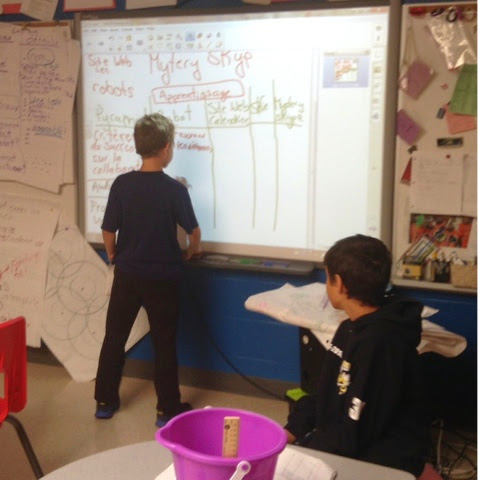
Students in teams unpacking the learning process of projects.


QR codes of the projects were posted and students were able to give feedback to classmates. They unpacked what is reflection, what is feedback and constructive criticism. These conversations lead into fixed mindset and growth mindset that we will continue unpacking by focusing on habits.

Students also shared their expertise on technology for the project. I did not teach them the how to of the tools they developed the skills to be successful and creative with the tools. (ShowMe, iMovie, Google presentation, Thinglink, Fotobabble, 30hands pro)

After 3 weeks, I am starting to see students understand that thinking is not just something you keep to yourself. It is what you can share, reflect, reapply, create, explain. Learning is a community full of feedback and new learning. The trust during learning with no judgement, increased risk taking for achieving and succeeding. We focused on the success and the improvements during tasks.With the open ended tasks students became problem solvers, designers (all scribble bots were different). They understood concepts of structures, electricity and developing French language through team conversations and explaining. We worked with our needs and built our learning community!

My goal is to make students confident, and think of school as a learning environment where they lead their learning, make mistakes for growth and design their thinking.


How are you encouraging growth, self-confidence, self regulation and collaboration?

The eportfolios for housing the tasks and reflecting about the process of learning.


Thursday, March 13, 2014

Why should students experience the real creation process?


Lat year my students enjoyed curiosity blocks and  I was to continue exploring this year and learn more about how students apply their skills to tasks of their own choice.  

This year with my English partner Carolyn Brambles and I decided to dedicate a block of 100 minutes a week not tied into the curriculum or teacher lead, only students lead curiosity of their choice on Fridays.

Students were in situations where they had to make decisions, problem solve and judge on what and how to create in any format, based on their own curiosity. The students and us struggled at the beginning into making sense of the process and how could this accountability becomes a reflective learning situation for all of us. 


Students ideas form the first curiosity camp. 

We used the same method as Educamp where students would write what they would like to learn, explore and what they could offer. We also provoked students' interest by watching Caine's arcade and Be more dog video- open to take risks. 

Through regular reflections the students and us improved.


First reflection form that lead to more understanding of the process. 

Who would think having students to decide to create was a large task!  We thought that students would tackle it easily. At the first camp, students could not make up their mind as to what they wanted to pursue as they were busy constantly checking what others were doing and changing their mind as they walked around the room.Once they decided what they would like to pursue and started formulating a plan monitoring the next steps and putting the plan into action, they started generating possibilities. They were formulating plans and the ideas were connecting and students were being strategic by conversing,reflecting and problem solving with each other.

The first attempts were not a failure rather a learning experience. By our third camp  the skills and strategies fell into place with their planning. Students pursued in accomplishing their desired task with a partner or individually. Students were experiencing many skills like; self regulation, creating, planning, conversing, reflecting, problem solving, integrating technology for researching as well as explaining or just recording the process online on a Google Doc or in a notebook. .

In the true sense of real learning experiences and full ownership of the learning process that they have explored and that they were immersed in.  Some students were programming games with Scratch , some students were playing and designing with Minecrat. Others were knitting, some designing origami and rainbow loom bracelets or key chains, headbands and animals. Some students were exploring Vietnamese style of painting as well. The amazing part of the whole block was the thinking and the reflective conversations during the tasks. 

Students among themselves were defining the importance of creation by proceeding with the skills and the strategies while completing the tasks of their creations.  


The second reflective form that students' completed focused on skills and strategies.


We need to give students a chance to experience and apply the skills and the strategies that they explore in class and be able to connect them to their choice of curiosity. Through this exploration students could create their own curriculum of their choice. You could call it genius hour or the 20% project like Google employee, giving students the freedom to pursue and be responsible for their curiosity with their own purpose of learning. How can we continue to spark students' passion?


Some  pictures and vine videos of their experiences.


Updated reflections after March Break: Students voices about the importance of skills to accomplish plans: So much learning from Students' reflections about giving them ownership of independent curiosity. 

Planning from the previous camps was important because then you will manage everything better.

J'ai appris que avant Curiosity Camp avoir un activite pour les autres peuvent apprendre. Ne pense pas que quelques va apporter un chose que tu veux d'apprendre, apporte ton activite.


I have learned that planning before Curiosity Camp helps with getting organized on the day of the camp, and it moves things along.

I think if you manage your time wisely, you can get ALOT more work done, so you wouldn't have to worry about it last minute.

I learned that if you manage time well then you will know when your game is great and you don't have to rush.

Organizing is important because you have things in right order and you know what'll happen next and what to DO next.

If your not organized you can't find your stuff that you need and everything is messy you need to be prepared. So then you know what to do.


I learned that taking/demonstrating initiative is important because that shows leadership.

By demonstrating initiative you can come up with great ideas and keep others on task. Also by taking initiative you and your team with feel like you got alot of work done.


i have learned that you should not change your goal even if it is hard try to do it.


That if you set goals you will achieve them and a good goal should be measurable. Goals need to have associated behaviors. There is a word for a goal without an associated behavior. It’s called a wish. For example I want to hold a handstand for 60 seconds. That is what I learned about goal setting.


I've learned that if you set a goal, you can achieve it by working hard and never giving up so you can reach the goal, you'll be happy at the end :)


Goal setting is so important during curiosity camp, and everywhere else because you won't know what you've accomplished unless you set a goal, and be proud when you accomplish it.


You have to be specific on what your goal is and you have to improve yourself to accomplish your goal.


I learned that if you have a plan it is easy to take initiative because you already know your goal and you don't need to be told what to do. Also if you take initiative then you can achieve your task.


Some vines of the Play4change Day