Sunday, September 7, 2014

The What, Why And How Of Fun On The First Week!

Exciting faces and laughs are a reminder of how lucky we are to be teachers and be able to work with students who become our new family in our learning shelter. 

I find it important to build this community of family as soon as the new members step in with so many wonders about their new home. It is important to immediately make this new home a happy and comfortable environment, Yes even on day one! Letting them connect and feel the ownership, the belonging, making decisions, having all voices recognized, the inventors, the wonders, the responsible and the joy of being together and respecting each other.   

The only instruction that I shared with the students were, where to line up outside for coming and leaving to and from school and how to change classrooms from French to English. I let them discover their needs as the day developed and had them make their decisions on where, how, when of daily routines and with whom to sit. Students discovered cupboards, closets, dug through school bags and around the classroom labeling in French their classroom needs. There was laughter and team collaboration. We will continue this activity by adding on questions for our needs. Some even labelled me as a need and Liam labelled himself being important for his team. Why was it fun? because it was unusual! It was a different first day, it was them moving, deciding, gathering together! 

Met my students through crumpled papers guessing names and selfies shared on Padlet of what makes them happy. 


The goals of the week where to let students explore through tasks to unpack skills of collaboration and self-regulation. Giving them opportunities to learn from and with each other on the first week. To have them feel the sense of accountability and the need to explain their thinking in second language. The videos below capture our tasks.


 Audioboo was introduced to capture voices of collaboration, voices of joy, attempting and sometimes succeeding, as well as communicating in a second language. We co-constructed the criteria on collaboration and the actions required to improve the French language. 

Throughout the tasks I was scaffolding students' attention to become the observers of their actions and reflect on team work.

listen to ‘Equipe 3 JKPB’ on Audioboo


Questions to focus on while I continue to establish the happy and comfortable environment:

Have I established the purpose of  the classroom environment?
Have I established the connections between the students and me?
Have I incorporated risk taking and ownership?
Have I thought of fun and  realistic tasks?
How will I  downgrade my control and promote autonomy?

Twitter is also my learning classroom. I am sharing a couple of tweets that I came across Saturday morning that reflect my thinking.


Tuesday, August 26, 2014

Because of the students!

I  look forward to another academic year in adapting the suggestions and reflections recommended from last year's students. To be an effective teacher, you must learn with and from the students. Listening, activating, learning and to become a skilled teacher I have to ask students to reflect on their learning and reflect on my interactions with them.

Teachers need to be open minded and not ruling out our learning by asking our students for their guidance and opinions. Making connections, being spontaneous in class and not to be always planned and to go beyond than just us being the only expertise in our classroom.  Living the fun learning process that engages us in learning than just delivering or mastering knowledge of content. Building that momentum of community of learners from the first day, having students decide on the how, the why and the if' in the classroom, will set that enriched community of learners and collaborative seekers.

As I looked through the students' recommendations for me from 2013 & 2014  academic year, they have guided my thinking ahead for this year. I asked students to share: What do I need to keep? What should I change? New ideas for ownership of learning on a Padlet and Google form for 214- 2015 academic year.


I value my students' feedback, they are the ones who impact my learning! I will continue to add fun and joy to everyday learning, I will focus more on mental health when we are learning. I will continue relating all learning to everyday and real life experiences through relevant tasks, creating context together and even at times looking like nontraditional learning.

The following are statements by the students that I copied from the form's responses:

Est ce que le classe peux avoir plus de coding? Beaucoup des personnes comme nous, aimons le scratch, et c'est bon pour apprendre.

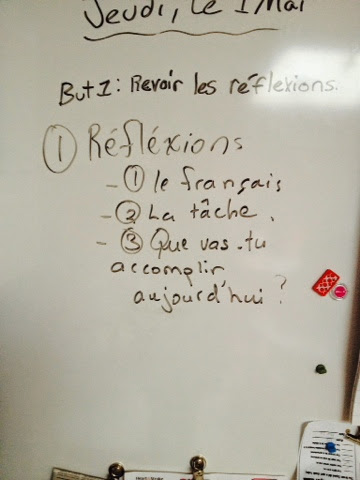
Dominic: Réflexions parce que je peux réfléchir sur mon apprentissage en classe. 
Les paddlers etait tres Bon 

Chaque jour, va sur radio canada pour les nouvelle. Ne change pas ca.
Lili
J'aime le classe de Mme T. parce que tout le temps tu interagir avec tout d'autre etudiants et j'aime Mme T. J'aime aussi les jeu avec Mme et d'autre etudiants. #2014 #MMETIBSHIRANI


Emma 
Cette annee etait merveilleux! Mes temps prefere etait We Day et St. Bridget's Camp (Le mud pit) :) J'aime tout l'anne, et tous qu'on a fait. Je pense que les reflexions serrait un bonne idee pour l'anne prochiane parce que tu doit reflechir, ou tu ne comprends pas, et aussi je pense que ca aide avec l'independence, responsabilite et l'organization. Aussi je pense que l'involvement avec Me to We c'est un tres bonne idee, parce que c'etait un tres bonne experience, et maintenent je sais beaucoup sur notre monde, et aussi We Day etait un experience que je ne vais pas oublier. Merci pour une annee pleind d'amusement, aprentissage, et pour etre la merveilleux proffesseure au monde.

I am looking forward to continue learning with my students in another exciting academic year. Instead of them having to thank me for a fun year, I need to thank them for letting me share my learning from them with the world.


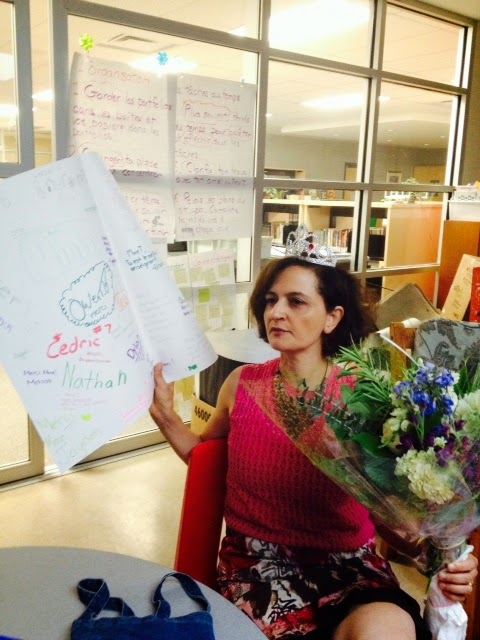
The students also surprised me at the end of the year by planning a video with the most amazing Mrs, Wilson. They planned the surprise with a presentation and a video.


The best learning is through play with the students. Are you as excited as I am and to be empowered by students for another year of learning?


Sunday, July 27, 2014

More Than Interactive Cardboard Boxes!

What do you get when you give students a chance to explore their own curiosity, plan for fundraising to make a change and science tinkering with electricity! Interactive arcade cardboard boxes for the whole school to participate and play for making a change.

I have shared a blog post about the curiosity blocks where students lead their own curiosities. Being involved with Free The Children, students decided to create arcade games during curiosity blocks and fund raise for building schools. Blog about Curiosity

This blog post  http://prendreactions.blogspot.ca/   by the Gr 6 students documents and explains all initiatives that they have organized For Free The Children. The students were also featured on Free The Children Blog about their creative fund raising. St-Gabriel-plays-change Free The Children

Students have already created the arcade games for the First Initiative for Play For Change . As a class we decided to keep the arcade boxes and turn them interactive to apply electricity (Science curriculum for Gr 6 students). We started with the fundamentals by exploring through several tasks at discovering what is static electricity and how is it applied in everyday life? What are circuits and how do switches activate circuits? What are the different kinds of switches? The overall expectations of the curriculum were unpacked by the students. Please see previous posts from this and last year explaining how students unpack the curriculum and set their learning. 

Students take ownership of learning when they are creating and producing. Through making students seize control of their thinking especially when they are reflecting during the process on what they have learned and how they have accomplished their creations. Classroom Blog on Electricity by Gr 6 students


As teachers we have to keep in mind that the work should be done by the students. We need to give students the chance to have a voice and control of their thinking, share learning, create, fail and learn from each other. These Interactions are about the assessment and the reflections that are part of the inquiry and thinking process. Through making, collaboration, problem solving and the sense of wondering are ignited which it reinforces skills to solve real problems.


This Padlet has some examples of students' creation on electricity:


Propelling Curiosity!

 It is important to provoke students' learning for curriculum inquiries in many exciting and innovative ways. It could be artifacts, videos, current event news, objects, interviews, wordles, pictures and even from a story book.  As teachers we always have to bring reality into the the inquiry process to connect real life experiences into everyday learning.

There are multiple ways of  propelling curriculum curiosity in class and inviting students to spark and ignite in questions that they never seem wanting to stop learning, sharing and collaborating that conversations become an ongoing vehicle of exploring and developing ownership of learning.  It is so exciting to see students push each others thinking and learning by questioning, seeking, pursuing, confirming, convincing, comparing their ongoing development of thinking and reflecting in depth on their learning.

Of course along the way students co-construct criteria not only for the purpose of reading, writing and speaking, also for the learning skills. These foci of strategies that overlap and extend thinking as well as learning skills (responsibility, self-regulation, collaboration, independence, organization and initiative) that loop and promote metacognition and reflection on learning. Reflecting (at the end and the beginning of the day) on learning, is what drives our thinking throughout the process and determines next steps and learning goals. It is explained in this post on Metacognitive Discussions.

The focus of this post, is to share some examples that created opportunities for thinking and provoking curiosity leading students in ownership of learning.  During this process, I become a mentor, a listener, an observer and an activator while students developed their curiosities. Students' questions always lead the inquiry process. Provoking focuses on students' questions, which is a very important step in letting them engage and take leadership and ownership of the process. The process is carried on with categorizing of the the questions then comparing them to the overall expectations of the curriculum.

These questions are a routine in activating conversations:

1- What do think is going on? Background knowledge
2- What makes you think this? Students support background knowledge and share the how and the why of their knowledge before searching to confirm and proceed to new learning. It is very import to give students this opportunity of building on each other's background knowledge and engage in conversations to pursue thinking and inquiries.  I love this stage as it solidifies their dependence of learning from each other then it provokes more thinking and further questioning actions and new inquiries through discussions. This is a very important step to takeby encourage listening, speaking and respecting other opinions and knowledge for further clarification of concepts.
 3- What would you wonder about? (After their discussions). What new learning are you wondering about? Throughout the year students develop searching skills, annotation for reading and choose ways to share new learning.

It takes time to immerse students in skills by providing exciting learning opportunities.We spend time building skills at the beginning of the year which become the core for our success and reflecting on these actions during the process to improve accountability.

There is so Much to share I will post some and every year I keep focusing on getting better at capturing the process through blogging. Some of the process captured on the Classroom Blog by the students  We focus on French daily that typing the process in English lags a little.

I seek the subject related examples off the news and social media.  Some examples of Science and Social Studies for provoking curriculum inquiries:


Science


Gr 6 


Ottawa's Great Forest  Before our walk to Beaver Pond

newfoundland-labrador/seal-product-ban-upheld-on-ethical-grounds-

canada/north/northerners-slam-wto-seal-products-decision-

Social Studies:
Gr 6
infographics-on-nelson-mandela  classroom Blog post about Mandela

snowden-docs-show-u-s-spied-during-G20-in-toronto-

it-wouldn-t-be-b-c-without-em-harper-jokes-about-vancouver-protesters

http://www.statsilk.com/maps/world-stats-open-data

If the-world-of-100 villages

-ottawa-canadiens-sotchi-mise-en-garde.

Nestle 'to act over child labour in cocoa industry' For Gr 5 on refugee and citizenship

Indian's exploited child cotton workers For Gr 5 on refugee and citizenship

etats-unis-malala-yousafzai-inspire- Gr 6 & 5


Gr 5
-confederation-line Ottawa’s world-class light rail

Justin-trudeau-removes-senators-from-liberal-caucus-

Comment organiser une cérémonie de citoyenneté


An example of students contribution after deconstructing the curriculum expectations:


Provoking learning does matter for curriculum inquiries. Students become so engaged with daily issues that themselves will continue searching and sharing realistic examples in everyday life experiences. What will you do to provoke your students curiosity this coming year? 

Tuesday, July 1, 2014

SWAT Team! How to search?

 The SWAT team, Students With Advanced Technology my Gr 6 and 5 students implemented technology with teachers, students and parents.  They created a site and a Google Calendar for booking.


They have explained many apps ( pic-collage, iMovie, Green screen, fotobabble, Audio Boo...) and Google Docs, GAPPS.


The students have covered many skills and applications for capturing the learning process through tech tools in class. It is important in class to give and allow time for students to explore how to use the tool, learn and reflect on how tools are useful for capturing learning.  These skills are important for students during production to minimize time and focus on the learning process than the tool itself. 

The SWAT team also prepared series of videos on Google searching. The students have uploaded some videos by Screen Capturing the search skills using Snagit. I have uploaded some videos from the Snagit Library on YouTube to share effective research for students by students. 


Three videos that I was unable to embed from YouTube of Ottawa Catholic Board Google account- advanced setting was the same as others. Time to use only ocsb for blogging.
Videos tips on


More on the SWAT Team SWAT team during Education Week


Sunday, June 1, 2014

Metacognitive discussions on determining learning goals!


I am sharing the process of metacognitive learning by determining individual learning goals and classroom learning goals.  This process is the base of a valuable connective platform of reflective conversational classroom community encouraging thinking, communication in learning and being clear about what students have accomplished and what needs to be accomplished.

On a daily basis students are given opportunities to engage in reflections in their learning and determining their next steps. The individual goals are shared with their teams, this collaborative thinking promotes questioning, ownership of learning, clarification of any content misconceptions and students converse about their goal setting of inquiry learning and next steps. This process makes learning transparent and it solidifies the classroom as a learning culture based on what individuals have learned and will reach. 

Using one chrome book per team students share their daily documented learning on Google Calenders that is embedded in their sites. As mentioned in previous posts Google is our Learning Platform for all activities. 

This connection also takes place face to face and digitally by inviting their colleagues to reply on next steps during learning tasks. They embrace each others' learning by having students voice on how to meet goals and share learning skills and strategies.  This creates a nurturing social, transparent and intellectual culture of learners committed by caring about each other's learning. 

The following are samples of connective learning:

Teams gather to listen, react and learn about reflective learning goals. 


Student on site sharing her reflective learning.


Students' reflections on Google Calender


We have le "professeur du jour" determining our whole group goals.


Not all reflections are digital some students to choose to write them on a daily basis 


I wished I had Google glasses as I always miss capturing many rich students ownership moment. I might invest in a pair this summer! 

All this learning is also articulated in French not only they are reflecting on their learning that is written in French also enriching their oral French through conversations. Students take risks in a second language and respect all entry levels of learning. Through this process as parents and students admit not only they have learned skills, strategies and content from each other, it has also improved their oral and written French. Through rich conversations on goal setting students take full ownership of learning during their tasks.  I will soon be posting more examples of oral rich conversations learning tasks. 

 We need to provide students with these reflective opportunities online, in writing and  face to face to constantly expose perspective of learning through an engaging community.


Students' partnership in learning!

As teachers we all look for partnership to grow professionally with colleagues and connecting with professionals on social media. I have always appreciated many blogs and tweets that make me reflect on many pedagogical learning experiences.

As mentioned in several posts on voice, inquiry and the ownership of learning, all credits are given to students for their partnership in learning. I was reading Aviva Dunsinger's post on Celebrating Learning  addressing students showcasing their work and how students are amazing teachers when given the choice. In recognition of #AboutThekids and catching up to my reflective blogging this post is dedicated to my teachers of Grade 6 and Grade 5/6 who make me celebrate and reflect on a daily basis.

I am sharing an example that took place with the whole school where students were to lead learning. The reason I am sharing this learning activity  is to demonstrate that every opportunity in class or out of class should always be  reflected on with students, by focusing on learning skills and how learning skills are always applied to any situations.

Students had an opportunity for a day mentoring the primary students through Math activities organized by Mathletes.  As students were mentoring, I had them reflect on their experiences on the classroom Twitter account. I have gathered their responses and videos of the day on a padlet. I am unable to share the live link as the videos are of many students from all grades.


All students' reflective tweets during the Math stations are the exact reflections that makes a classroom a learning space. 

The tweets were about:
  •  The importance of collaboration when teaching and learning
  •   Positive feedback during activities
  •  Motivating students by giving them a hint or a question to provoke their thinking.
  •  Learning the Math content with the other students while teaching and explaining
  •  Learning is fun when students are talking
  •   Lots of fun when students were engaged with learning
  •  Students listened and persevered when they were challenged
  •  Students were accountable at completing their tasks and never gave up
  •  Learning through games is motivating.


 Students' reflection mirrored what happens in the classroom and how important to always take advantage of all learning situations and reflect to improve learning skills. I enjoy watching students every year take full ownership and responsibility of learning and perseverance to inquire for learning and share their learning. Teachers who regularly visit my classroom or see my students in action at school or out of school wonder, how do we do it! It is about reflective learning on a daily basis by focusing on learning skills and actions taken to master tasks through skills.