How will we ensure that learning goes beyond the classroom?
How do we ensure students get engaged in history?
How do we ensure that the learning is rich and deep enough that every students finds passion of learning?
Strong provocations hook students to passionate learning and critical thinking. Capturing students passion through experiences that leads to interactions, questioning and discussions of historical events. We began our historical analyzation by Exploring the The Giant Floor Map of 1812 from The Canadian National Geographic. In a previous post on unpacking what is history and Geography? Since early October up to now students are still referring to their experiences of the War of 182 and are familiar with the concept of events and timelines. Building knowledge of the first inhabitants in Canada and how they have arrived and adapted to the arrival of the Europeens. From a living library with aboriginal artifacts to the Blanket exercise with my English partner Ms Brambles. Visiting the virtual museum and building individual passion by exploring aboriginal peoples needs. Now we are immersed in the learning of WWI through WW1 Kit form the War Museum. Students have gone home and independently continued searching and sharing their excitement about history through building of lego. iMovies, Powtoon, Google presentations. Students are excited about reading and synthesizing the historical aspects, causes, effects and perspectives. Students are applying their historical knowledge through conversations with respect to the facts from long ago that shaped our lives today.
The passion for learning is stretching students thinking and learning by slowing down to allow them ownership of explorations, discussions. Passion for learning is living the moment for quality rather than quantity of learning, allowing the curiosity to flow and build a learning community of new concepts through many provocations and thinking skills.
Sunday, October 26, 2014

Sunday, October 12, 2014
Connected Educators!
Last weekend I was privileged to attend the Ottawa GAFE summit. It was an honor to meet with colleagues whom I already connect and learn with as well as meeting Canadian and international educators whom enhanced my technological skills and confirmed classroom learning process.
I recommend Kern Kelley, Jim Sill and Monica Martinez for international presenter on technology. I attended Julie Millan's session on For, As, Of Learning: Using Google Apps to Integrate Assessment Practices to which I connected to her presentation and gave me the boost and excitement of confirming what I practice in class with my students before my presentation on How GAPPS Support Thinking and Transparency of learning joined by Cathryn Wake for English Junior and Primary samples.
The reason I choose to only add links to my whole presentation is because I believe to only speak to real evidence of students' thinking. Most of the process that I spoke to, I have been developing for three years now and that I continue to enhance with my students and find a purpose for empowering students' reflection and giving them a chance to speak to their learning process and their thinking.
I also spoke to the" seeing and hearing" of the students' voice when collecting evidence of learning with students for their parents. I had a Google doc during the presentations that had links from the past years to the present showing 'the how' and 'the what' of students' voice and empowering growth through digital portfolios.
Thanks to Cathryn Wake for joining in and showing her application from last years' Grade four students and tempting Google with the Gr 1's. Thanks to Natalie MacDonald for sharing all of the Grade one digitable collaboration with Jennifer Flinn. Thanks also to all who attended and their feedback. Thanks to Jennifer King for staying after her presentation and her feedback while presenting.
I would also like to thank Karen McEvoy for inviting me to be part of Learning Connections and evolving through the years with the skills of learning and being a connected educator by sharing, exploring and reflecting with colleagues on my learning process through technology from my students.
On my twitter connection today I came across this tweet by Tom Whitby.It is true that as educators we need to have a mindset of learning, collaborating, reflecting to become a conceptual teacher focusing on the process of learning than the product of learning and using technology when appropriate for teaching and learning.
I recommend Kern Kelley, Jim Sill and Monica Martinez for international presenter on technology. I attended Julie Millan's session on For, As, Of Learning: Using Google Apps to Integrate Assessment Practices to which I connected to her presentation and gave me the boost and excitement of confirming what I practice in class with my students before my presentation on How GAPPS Support Thinking and Transparency of learning joined by Cathryn Wake for English Junior and Primary samples.
The reason I choose to only add links to my whole presentation is because I believe to only speak to real evidence of students' thinking. Most of the process that I spoke to, I have been developing for three years now and that I continue to enhance with my students and find a purpose for empowering students' reflection and giving them a chance to speak to their learning process and their thinking.
I also spoke to the" seeing and hearing" of the students' voice when collecting evidence of learning with students for their parents. I had a Google doc during the presentations that had links from the past years to the present showing 'the how' and 'the what' of students' voice and empowering growth through digital portfolios.
Thanks to Cathryn Wake for joining in and showing her application from last years' Grade four students and tempting Google with the Gr 1's. Thanks to Natalie MacDonald for sharing all of the Grade one digitable collaboration with Jennifer Flinn. Thanks also to all who attended and their feedback. Thanks to Jennifer King for staying after her presentation and her feedback while presenting.
I would also like to thank Karen McEvoy for inviting me to be part of Learning Connections and evolving through the years with the skills of learning and being a connected educator by sharing, exploring and reflecting with colleagues on my learning process through technology from my students.
On my twitter connection today I came across this tweet by Tom Whitby.It is true that as educators we need to have a mindset of learning, collaborating, reflecting to become a conceptual teacher focusing on the process of learning than the product of learning and using technology when appropriate for teaching and learning.
Connectedness for an educator must be a mindset for learning. w/o it, Tech is just a bunch of bells and whistles. @LynneOakvik #Edchat #ce14
— Tom Whitby (@tomwhitby) October 10, 2014
Sunday, September 28, 2014
We should never assume what students know!
Our school received the Giant map of 1812 from the Canadian Geography. These giant maps are perfect for students' inquiries on Canadian History, Geography and Science. If you have not ordered one visit The Canadian Geographic Site for the Giant floor Maps
Provoking (Previous post) is the most important step for inquiry especially relating to the current Canadian and world issues. The Franklin Expedition was on the news and we began our discussion on why is it important for Canada to spend money retrieving the expedition? Why did Stephen Harper show an interest in visiting the site?
I was presenting the social studies curriculum to the Gr 5/6 students to start our inquiry about the Canadian History and Geography. I told my students that history is all about asking questions.
I thought I would ask the first question what is History and Geography? It was so interesting to find out students' reaction in teams and brainstorming of the two concepts. History was a little easier as they had some knowledge and no idea about Geography!
Hold on! Before I proceed with the war of 1812 and unpacking the overall expectations of the Social Studies Curriculum., An unexpected great discussion was necessary that I assumed students knew!
I gave students time to explore posters from the Legion about Canadian participation in wars. I had just participated in the Army Run and shared my shirt that showed celebrating
100 years of WWI. We revisited the graph on what they knew about History and Geography and so many more ideas were provoked and added.


By analyzing the meaning of history and geography and taking time at exploring these general concepts students have developed a meaning and interest at not only looking at the passed, also at reasons for our existence of where we are and provoked discussions and interest in exploring so much more of the changes, effects and how do we know what we know?
Provoking (Previous post) is the most important step for inquiry especially relating to the current Canadian and world issues. The Franklin Expedition was on the news and we began our discussion on why is it important for Canada to spend money retrieving the expedition? Why did Stephen Harper show an interest in visiting the site?
I was presenting the social studies curriculum to the Gr 5/6 students to start our inquiry about the Canadian History and Geography. I told my students that history is all about asking questions.
I thought I would ask the first question what is History and Geography? It was so interesting to find out students' reaction in teams and brainstorming of the two concepts. History was a little easier as they had some knowledge and no idea about Geography!
Hold on! Before I proceed with the war of 1812 and unpacking the overall expectations of the Social Studies Curriculum., An unexpected great discussion was necessary that I assumed students knew!
I gave students time to explore posters from the Legion about Canadian participation in wars. I had just participated in the Army Run and shared my shirt that showed celebrating
100 years of WWI. We revisited the graph on what they knew about History and Geography and so many more ideas were provoked and added.


By analyzing the meaning of history and geography and taking time at exploring these general concepts students have developed a meaning and interest at not only looking at the passed, also at reasons for our existence of where we are and provoked discussions and interest in exploring so much more of the changes, effects and how do we know what we know?
An unplanned discussion by listening to students is important. The extra time spent on this discussion engaged students' focus and perception of presumably simple knowledge to excitement and inquiry through the the curriculum that they will start this week.
The map also provoked an understanding of historical events prior to 1812 for the G5 curriculum and historical Canadian identity and contributions for the Gr6.
It was a powerful, unexpected progression in which the students became completely aware about the reasons and impact of history and geography. I do not regret taking that extra time as it merged them into a meta-inquiry of why we learn history and geography.
This made think do we always have to rush through the planned activity? Do we have to rush from activity to activity?
A short video of the Gr 5 historians and geographers on the map of 181.
The Padlet for provoking historical and geographical events.

Sunday, September 21, 2014
Why A Learning Community?
After spending two weeks on building collaborative skills, the accountability of learning, designing and reflecting on the learning process. Self-regulation became a focus during the learning process while collaborating. How do I stay accountable during distractions? How do I commit to compromise during team discussions? How do I build and learn from my teams' thinking? What is designing a project? Why create and explain my learning?
Students were given opportunities to reflect and fortify the thinking skills when designing and creating a task. Students reflected on the importance of learning outcomes when creating and found that creating is more than just assembling items or objects together.
The students pointed that throughout the process of building the scribble bot, they were:


QR codes of the projects were posted and students were able to give feedback to classmates. They unpacked what is reflection, what is feedback and constructive criticism. These conversations lead into fixed mindset and growth mindset that we will continue unpacking by focusing on habits.
Students also shared their expertise on technology for the project. I did not teach them the how to of the tools they developed the skills to be successful and creative with the tools. (ShowMe, iMovie, Google presentation, Thinglink, Fotobabble, 30hands pro)
After 3 weeks, I am starting to see students understand that thinking is not just something you keep to yourself. It is what you can share, reflect, reapply, create, explain. Learning is a community full of feedback and new learning. The trust during learning with no judgement, increased risk taking for achieving and succeeding. We focused on the success and the improvements during tasks.With the open ended tasks students became problem solvers, designers (all scribble bots were different). They understood concepts of structures, electricity and developing French language through team conversations and explaining. We worked with our needs and built our learning community!
My goal is to make students confident, and think of school as a learning environment where they lead their learning, make mistakes for growth and design their thinking.


How are you encouraging growth, self-confidence, self regulation and collaboration?
The eportfolios for housing the tasks and reflecting about the process of learning.


Students were given opportunities to reflect and fortify the thinking skills when designing and creating a task. Students reflected on the importance of learning outcomes when creating and found that creating is more than just assembling items or objects together.
The students pointed that throughout the process of building the scribble bot, they were:
- Thinking
- Trying and retrying.
- Problem solving
- Confirming learning and discovering new learning
- Referring to criteria for expectations
- Covering learning concepts: French Science Social Studies Arts Math
- Collaborating
- Learning from the team
- Having conversations
- Reflecting, and adjusting
- Improving, through many attempts, there was lots of growth
- Accepting, feedback- from team members
- Compromising on ideas
- Stopping. thinking and deciding
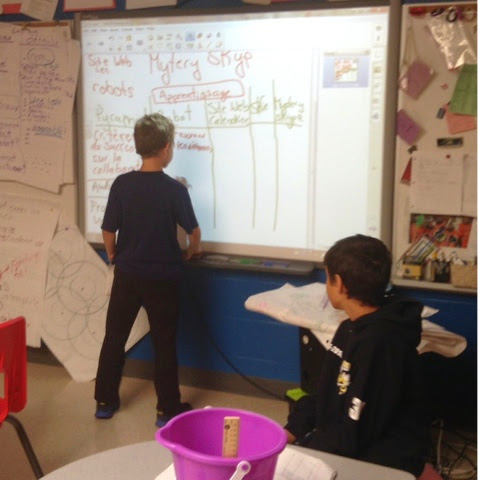
Students in teams unpacking the learning process of projects.


Students also shared their expertise on technology for the project. I did not teach them the how to of the tools they developed the skills to be successful and creative with the tools. (ShowMe, iMovie, Google presentation, Thinglink, Fotobabble, 30hands pro)
After 3 weeks, I am starting to see students understand that thinking is not just something you keep to yourself. It is what you can share, reflect, reapply, create, explain. Learning is a community full of feedback and new learning. The trust during learning with no judgement, increased risk taking for achieving and succeeding. We focused on the success and the improvements during tasks.With the open ended tasks students became problem solvers, designers (all scribble bots were different). They understood concepts of structures, electricity and developing French language through team conversations and explaining. We worked with our needs and built our learning community!
My goal is to make students confident, and think of school as a learning environment where they lead their learning, make mistakes for growth and design their thinking.


How are you encouraging growth, self-confidence, self regulation and collaboration?
The eportfolios for housing the tasks and reflecting about the process of learning.
Sunday, September 14, 2014
All About Learning Experiences!
Yes I have not tackled the curriculum content yet! I am still creating learning situations for students to unpack, why collaborate? How to collaborate? What is a task? What is thinking? and What is creating?
These learning experiences are life long skills that would embed in any content and any situations at school and outside school. They are skills and habits that students need to be immersed in and for themselves to develop react and reflect.
Yes of course there are moments that are chaotic, unexpected, as it should be! Teachers need to know the real meaning of scaffolding during all learning experiences, when to stop the whole class and react to the situation, reflect and readjust. These situations become the co-constructed expectations for building a community of risk takers, amplifying students' voices , students becoming accountable, reflectors and owners of learning from these experiences.
Many learning situations throughout the year are successful and unsuccessful, how are we taking the responsibility of owning the learning and reflecting?
During week two we consolidated on the criteria of collaboration. On a daily basis and even throughout the tasks we are determining individual goals on the collaborative criteria, stopping, reflecting and resetting goals. Last week post explains collaborative tasks.
The best moment was when students began discovering that learning is a community. In groups they were writing questions to promote french oral conversations about daily needs. Students come with a backpack of knowledge, we need to give them a chance to share it and learn from each other. In groups they shared their questions and already learned from each other the verbs, the format of questioning. I gave them time to share and add their new learning in their French notebooks.


These learning experiences are life long skills that would embed in any content and any situations at school and outside school. They are skills and habits that students need to be immersed in and for themselves to develop react and reflect.
Yes of course there are moments that are chaotic, unexpected, as it should be! Teachers need to know the real meaning of scaffolding during all learning experiences, when to stop the whole class and react to the situation, reflect and readjust. These situations become the co-constructed expectations for building a community of risk takers, amplifying students' voices , students becoming accountable, reflectors and owners of learning from these experiences.
Many learning situations throughout the year are successful and unsuccessful, how are we taking the responsibility of owning the learning and reflecting?
During week two we consolidated on the criteria of collaboration. On a daily basis and even throughout the tasks we are determining individual goals on the collaborative criteria, stopping, reflecting and resetting goals. Last week post explains collaborative tasks.
The best moment was when students began discovering that learning is a community. In groups they were writing questions to promote french oral conversations about daily needs. Students come with a backpack of knowledge, we need to give them a chance to share it and learn from each other. In groups they shared their questions and already learned from each other the verbs, the format of questioning. I gave them time to share and add their new learning in their French notebooks.


Meaningful learning experiences are, when students are given opportunities to take ownership, reflect, share learning and apply it. A meaningful learning community is a community of respect for opinions, respect for sharing thinking, questioning, adapting when reflecting.
This week we also explored what is creating and explaining based on last week's project on the scribble bot. Students' described what is creating, how to explain about the scribble bot and how to capture learning by using some tech tools. Lots of thinking, unpacking of learning that students will continue reflecting on, creating, explaining, sharing learning and skills on using tech tools. Lots ahead!
Some pictures of week two of students' experiences at learning.


What will be your students' learning experiences this coming week? We have lots ahead to revisit and reflect. I would love to hear about your experiences with your students!
Thank you for the feedback from last week's post and so exciting to have teachers try the sticky notes needs in class. As promised I will share our next steps. Students categorized the items and wrote questions about their needs since we are French language learners class. A group also took ownership of finding the cost of the items as we are learning to be a caring community . I had the students reflect on this video:
With students' permission I am sharing a couple of projects on explaining:
A link to 30 hands about the Scribble Bot: 30 Hands Pro Another video: Sharing learning
Sunday, September 7, 2014
The What, Why And How Of Fun On The First Week!
Exciting faces and laughs are a reminder of how lucky we are to be teachers and be able to work with students who become our new family in our learning shelter.
I find it important to build this community of family as soon as the new members step in with so many wonders about their new home. It is important to immediately make this new home a happy and comfortable environment, Yes even on day one! Letting them connect and feel the ownership, the belonging, making decisions, having all voices recognized, the inventors, the wonders, the responsible and the joy of being together and respecting each other.
The only instruction that I shared with the students were, where to line up outside for coming and leaving to and from school and how to change classrooms from French to English. I let them discover their needs as the day developed and had them make their decisions on where, how, when of daily routines and with whom to sit. Students discovered cupboards, closets, dug through school bags and around the classroom labeling in French their classroom needs. There was laughter and team collaboration. We will continue this activity by adding on questions for our needs. Some even labelled me as a need and Liam labelled himself being important for his team. Why was it fun? because it was unusual! It was a different first day, it was them moving, deciding, gathering together!
Met my students through crumpled papers guessing names and selfies shared on Padlet of what makes them happy.


The goals of the week where to let students explore through tasks to unpack skills of collaboration and self-regulation. Giving them opportunities to learn from and with each other on the first week. To have them feel the sense of accountability and the need to explain their thinking in second language. The videos below capture our tasks.
Audioboo was introduced to capture voices of collaboration, voices of joy, attempting and sometimes succeeding, as well as communicating in a second language. We co-constructed the criteria on collaboration and the actions required to improve the French language.
Throughout the tasks I was scaffolding students' attention to become the observers of their actions and reflect on team work.
listen to ‘Equipe 3 JKPB’ on Audioboo
Questions to focus on while I continue to establish the happy and comfortable environment:
Have I established the purpose of the classroom environment?
Have I established the connections between the students and me?
Have I incorporated risk taking and ownership?
Have I thought of fun and realistic tasks?
How will I downgrade my control and promote autonomy?
Twitter is also my learning classroom. I am sharing a couple of tweets that I came across Saturday morning that reflect my thinking.
Questions to focus on while I continue to establish the happy and comfortable environment:
Have I established the purpose of the classroom environment?
Have I established the connections between the students and me?
Have I incorporated risk taking and ownership?
Have I thought of fun and realistic tasks?
How will I downgrade my control and promote autonomy?
Twitter is also my learning classroom. I am sharing a couple of tweets that I came across Saturday morning that reflect my thinking.
“@pernilleripp: A great learning environment has room for all people to learn, including the teacher #satchat” #cdnedchat #ocsb
— Rola Tibshirani (@rolat) September 6, 2014
“@shaunyk: My visual notes from @shareski excellent keynote on planning for joy #gafesummit pic.twitter.com/nfzO1szGS8” #joy #cdnedchat
— Rola Tibshirani (@rolat) September 6, 2014
Tuesday, August 26, 2014
Because of the students!
I look forward to another academic year in adapting the suggestions and reflections recommended from last year's students. To be an effective teacher, you must learn with and from the students. Listening, activating, learning and to become a skilled teacher I have to ask students to reflect on their learning and reflect on my interactions with them.
Teachers need to be open minded and not ruling out our learning by asking our students for their guidance and opinions. Making connections, being spontaneous in class and not to be always planned and to go beyond than just us being the only expertise in our classroom. Living the fun learning process that engages us in learning than just delivering or mastering knowledge of content. Building that momentum of community of learners from the first day, having students decide on the how, the why and the if' in the classroom, will set that enriched community of learners and collaborative seekers.
As I looked through the students' recommendations for me from 2013 & 2014 academic year, they have guided my thinking ahead for this year. I asked students to share: What do I need to keep? What should I change? New ideas for ownership of learning on a Padlet and Google form for 214- 2015 academic year.

Teachers need to be open minded and not ruling out our learning by asking our students for their guidance and opinions. Making connections, being spontaneous in class and not to be always planned and to go beyond than just us being the only expertise in our classroom. Living the fun learning process that engages us in learning than just delivering or mastering knowledge of content. Building that momentum of community of learners from the first day, having students decide on the how, the why and the if' in the classroom, will set that enriched community of learners and collaborative seekers.
As I looked through the students' recommendations for me from 2013 & 2014 academic year, they have guided my thinking ahead for this year. I asked students to share: What do I need to keep? What should I change? New ideas for ownership of learning on a Padlet and Google form for 214- 2015 academic year.
The following are statements by the students that I copied from the form's responses:
Est ce que le classe peux avoir plus de coding? Beaucoup des personnes comme nous, aimons le scratch, et c'est bon pour apprendre.
Dominic: Réflexions parce que je peux réfléchir sur mon apprentissage en classe.
Les paddlers etait tres Bon
Chaque jour, va sur radio canada pour les nouvelle. Ne change pas ca.
Lili
J'aime le classe de Mme T. parce que tout le temps tu interagir avec tout d'autre etudiants et j'aime Mme T. J'aime aussi les jeu avec Mme et d'autre etudiants. #2014 #MMETIBSHIRANI
Emma
Cette annee etait merveilleux! Mes temps prefere etait We Day et St. Bridget's Camp (Le mud pit) :) J'aime tout l'anne, et tous qu'on a fait. Je pense que les reflexions serrait un bonne idee pour l'anne prochiane parce que tu doit reflechir, ou tu ne comprends pas, et aussi je pense que ca aide avec l'independence, responsabilite et l'organization. Aussi je pense que l'involvement avec Me to We c'est un tres bonne idee, parce que c'etait un tres bonne experience, et maintenent je sais beaucoup sur notre monde, et aussi We Day etait un experience que je ne vais pas oublier. Merci pour une annee pleind d'amusement, aprentissage, et pour etre la merveilleux proffesseure au monde.
I am looking forward to continue learning with my students in another exciting academic year. Instead of them having to thank me for a fun year, I need to thank them for letting me share my learning from them with the world.
The students also surprised me at the end of the year by planning a video with the most amazing Mrs, Wilson. They planned the surprise with a presentation and a video.
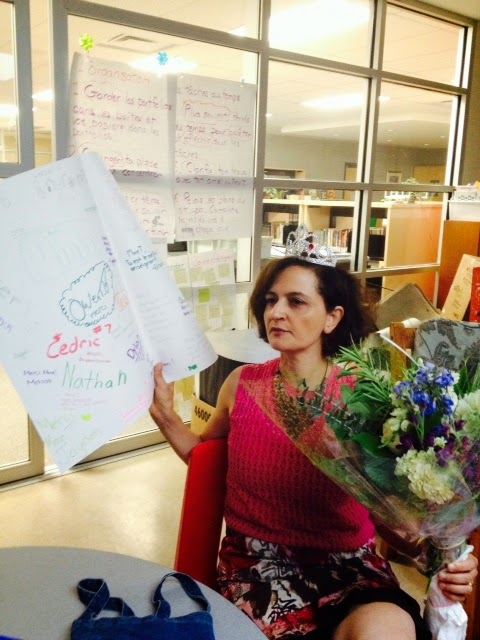
The best learning is through play with the students. Are you as excited as I am and to be empowered by students for another year of learning?
Subscribe to:
Posts (Atom)