Sunday, November 30, 2014

Are Learning Communities effective?

An overdue post since superb conferences like GAFE and  BIT14 as well as amazing learning opportunities from our board the New Pedagogies for Deep Learning (NPDL) to the Learning Connection core team and our planning for December 10th face to face sharing with many colleagues from across the board.

Those three weeks in November have impacted my learning by curating more to my thinking. These thinking skills have confirmed and encouraged to deepen my practice with colleagues and my students.

On Saturday morning on twitter I came across this very pertinent tweet:


So true, without collaboration our growth is limited! These learning opportunities are always a result of collaborating face to face with colleagues. They have been a vaccination of thinking opportunities that jolts us to persevere and persist in our adventure with our students.

On Friday, being part of Learning Connection team and unpacking the 6 C`s  by Michael Fullan New Pedagogies for Deep Learning with my colleagues, tasks focused on the competencies of deep learning, These collaborative thinking tasks got the best out of us by developing a culture of collaborative thinking just like we are expected in our classroom.

The focus is always on the process of thinking skills not just the tools. We further explored concepts of tools, ideas on getting started and ideas for the classroom.  This culture of  collaborative learning takes determination, a culture of `yes`to collaboration, powerful pedagogical influences and seeking support with each other and empowering us to connect these pathways to our students.

As we expect from us to be learning partners with our students the same takes place at these meetings. Karen allows us to be in partnership in learning from and with each other as she permits for team collaboration of unpacking the thinking skills as she also becomes a learner with and from us.

These cultures of learning opportunities are permissions provided for us to allow us to take risks with our learning giving and taking back to our colleagues at school as well as our students where the transformational learning takes place.

As learning leaders where are we on these daily leadership journeys? How are we being grateful to collaborate and share our learning?
My learning is surely influenced on a daily basis from my colleagues at school, at the board office and colleagues from all school boards in Ottawa, Ontario and my large learning staff room twitter.

We need to always keep a positive learning perseverance, take those risks and keep connected for more learning practices and accept that learning is messy!

What new learning will I be trying with my students? I guess I need to keep publishing more of my posts rather than keeping them in draft. I should spend more time sharing the risk taking process of learning with my students.


Sunday, November 2, 2014

Google Drawing And Documenting Learning

We have used many tools for capturing the thinking process and documenting our learning, from Audio Boom , explain everything and other IOS apps as well as GAPPS. In this post, I chose to share documentation of learning through Google Drawing. The students have been applying Google Drawing for explaining their thinking and learning since September. The students document their learning process by uploading it on the eportofolios. We have used Google Drawing with Keizena, attaching a link for the criteria on the drawing, checking for comprehension of a text, and screencasting for evidence of applying feedback.

Google drawing with Keizena: Many layers of sharing and documenting.

1- By commenting, this student explained her favorite photo taken during the Terry Fox walk in September at Kanata's Beaver Pond.


2- The student added a link to the same image, explaining her 2 other photos about the Beaver Pond in relation to the same image. At the top of this image the student's initials LC and next the link. 


3-The link leads to  the Google Drawing that explains what is in common of the 3 photos.


4- Students also added their voices to the Google drawing and teacher's  feedback was also recorded.


Google Drawing and success criteria attached on the Drawing. 


A student explained First Nation People adaptation to the environment. When the title (Les Algonquins) is clicked  the  document of the success criteria that is attached will be viewed for feedback.  The students made a copy of the original document of the criteria, shared and attached it to the drawing.


Google Drawing and assessment for reading comprehension


The students  either labeled the events or ordered the boxes after reading a text for a comprehension self assessment. 


We were very fortunate to have the WW1 supply Line Kit from the War Museum. The students created a Google Drawing explaining their feelings about the war by using the strategy CSI ( Color, Symbol and image). One of our focuses was to improve the French grammar, after feedback from the teacher, the students recorded the evidence of the feedback by using the extension screencastify or snagit.


The following video was uploaded on student's YouTube account:


Another video explaining how feedback was applied was uploaded on my YouTube account using my laptop as some students had difficulties connecting on the Chromebook with the extension.


Students connected  many skills when applying technology for documenting learning: 
  •  Responsibility and ownership of learning for providing evidence of the co-constructed criteria of tasks and learning goals, 
  •  The responsibility of planing, monitoring, assessing by peer, teacher and self-assessment,  promoting students' control of their own learning by being mindful, intentional and self-directed. 
  • Relating skills to self -regulation of the metacognitive process by promoting problem solving, trying and retrying,  applying many strategies, clarification of expectations, reflective questioning for their own perspective of designing learning. 
  • Collaboration for sharing, articulating their own learning .
  • Organization plays a big part of this process as students document their learning and upload to their eportfolios.
We will continue building skills focusing on the learning process with many tools for metacognitive purpose and making learning visible by the students for their classmates, their parents and for a global audience. Some self-reflective questioning that guides me while planning are:
  • Were the expectations clear?
  • Did I set a positive environment of trying and retrying by consolidating with my students?
  • Did I provide the time for learners questioning about the process?
  • Did I ensure learners were motivated? (Provocation so important)
  • Did I provide the resources for scaffolding and feedback?

Sunday, October 26, 2014

When students become passionate about History!

How will we ensure that learning goes beyond the classroom?

How do we ensure students get engaged in history?

How  do we ensure that the learning is rich and deep enough that every students finds passion of learning?

Strong provocations hook students to passionate learning and critical thinking. Capturing students passion through experiences that leads to interactions, questioning and discussions of historical events. We began our historical analyzation by Exploring the The Giant Floor Map of 1812 from The Canadian National Geographic.  In a previous post on unpacking what is history and Geography? Since early October up to now students are still referring to their experiences of the War of 182 and are familiar with the concept of events and timelines. Building knowledge of the first inhabitants in Canada and how they have arrived and adapted to the arrival of the Europeens.  From a living library with aboriginal artifacts to the Blanket exercise with my English partner Ms Brambles. Visiting the virtual museum and building individual passion by exploring aboriginal peoples needs. Now we are immersed in the learning of WWI through WW1 Kit form the War Museum. Students have gone home and independently continued searching and sharing their excitement about history through building of lego. iMovies, Powtoon, Google presentations. Students are excited about reading and synthesizing the historical aspects, causes, effects and perspectives. Students are applying their historical knowledge through conversations with respect to the facts from long ago that shaped our lives today.

The passion for learning is stretching students thinking and learning by slowing down to allow them ownership of explorations, discussions. Passion for learning is living the moment for quality rather than quantity of learning,  allowing the curiosity to flow and build a learning community of new concepts through many provocations and thinking skills.

Sunday, October 12, 2014

Connected Educators!

Last weekend I was privileged to attend the Ottawa GAFE summit.  It was an honor to meet with colleagues whom I already connect and learn with as well as meeting Canadian and international educators whom enhanced my technological skills and confirmed classroom learning process.

I recommend Kern Kelley, Jim Sill and Monica Martinez for international presenter on technology.  I attended Julie Millan's session on For, As, Of Learning: Using Google Apps to Integrate Assessment Practices to which I connected to her presentation and gave me the boost and excitement of confirming what I practice in class with my students before my presentation on  How GAPPS Support Thinking and Transparency of learning joined by Cathryn Wake for English Junior and Primary samples.

The reason I choose to only add links to my whole presentation is because I believe to only speak to real evidence of students' thinking. Most of the process that I spoke to, I have been developing for three years now and that I continue to enhance with my students and find a purpose for empowering students' reflection and giving them a chance to speak to their learning process and their thinking.

I also spoke to the" seeing and hearing" of the students' voice when collecting evidence of learning with students for their parents. I had a Google doc during the presentations that had links from the past years to the present showing 'the how' and 'the what' of students' voice and empowering growth through digital portfolios.

Thanks to Cathryn Wake for joining in and showing her application from last years' Grade four students and tempting Google with the Gr 1's. Thanks to Natalie MacDonald for sharing all of the Grade one digitable collaboration with Jennifer Flinn. Thanks also to all who attended and their feedback. Thanks to Jennifer King for staying after her presentation and her feedback while presenting.

I would also like to thank Karen McEvoy for inviting me to be part of Learning Connections and evolving through the years with the skills of learning and being a connected educator by sharing, exploring and reflecting with colleagues on my learning process through technology from my students.

On my twitter connection today I came across this tweet by Tom Whitby.It is true that as educators we need to have a mindset of learning, collaborating, reflecting to become a conceptual teacher focusing on the process of learning than the product of learning and using technology when appropriate for teaching and learning.


Sunday, September 28, 2014

We should never assume what students know!

Our school received the Giant map of 1812 from the Canadian Geography. These giant maps are perfect for students' inquiries on Canadian History, Geography and Science. If you have not ordered one visit The Canadian Geographic Site for the Giant floor Maps

Provoking (Previous post) is the most important step for inquiry especially relating to the current Canadian and world issues. The Franklin Expedition was on the news and we began our discussion on why is it important for Canada to spend money retrieving the expedition? Why did Stephen Harper show an interest in visiting the site?

I was presenting the social studies curriculum to the Gr 5/6 students to start our inquiry about the Canadian History and Geography. I told my students that history is all about asking questions.
I thought I would ask the first question what is History and Geography? It was so interesting to find out students' reaction in teams and brainstorming of the two concepts. History was a little easier as they had some knowledge and no idea about Geography!

Hold on! Before I proceed with the war of 1812 and unpacking the overall expectations of the Social Studies Curriculum., An unexpected great discussion was necessary that I assumed students knew!

I gave students time to explore posters from the Legion about Canadian participation in wars. I had just participated in the Army Run and shared my shirt that showed celebrating
100 years of WWI.  We revisited  the graph on what they knew about History and Geography and so many more ideas were provoked and added.


By analyzing the meaning of history and geography and taking time at exploring these general concepts students have developed a meaning and interest at not only looking at the passed, also at reasons for our existence of where we are and provoked discussions and interest in exploring so much more of the changes, effects and how do we know what we know?

An unplanned discussion by listening to students is important. The extra time spent on this discussion engaged students' focus and perception of presumably simple knowledge to excitement and inquiry through the the curriculum that they will start this week. 

The map also provoked an understanding of historical events prior to 1812 for the G5 curriculum and historical Canadian identity and contributions for the Gr6.

It was a powerful, unexpected progression in which the students became completely aware about the reasons and impact of history and geography. I do not regret taking that extra time as it merged them into a meta-inquiry of why we learn history and geography. 

This made think do we always have to rush through the planned activity?  Do we have to rush from activity to activity? 

A short video of the Gr 5 historians and geographers on the map of 181.


The Padlet for provoking historical and geographical events. 


Sunday, September 21, 2014

Why A Learning Community?

After spending two weeks on building collaborative skills, the accountability of learning, designing and reflecting on the learning process. Self-regulation became a focus during the learning process while collaborating. How do I stay accountable during distractions? How do I commit to compromise during team discussions? How do I build and learn from my teams' thinking? What is designing a project? Why create and explain my learning?

Students were given opportunities to reflect and fortify the thinking skills when designing and creating a task. Students reflected on the importance of learning outcomes when creating and found that creating is more than just assembling items or objects together.

The students pointed that throughout the process of building the scribble bot, they were:
  • Thinking
  • Trying and retrying.
  • Problem solving
  • Confirming learning and discovering new learning
  • Referring to criteria for expectations
  • Covering learning concepts: French Science Social Studies Arts Math
  • Collaborating
  • Learning from the team
  • Having conversations
  • Reflecting, and adjusting
  • Improving, through many attempts, there was lots of growth
  • Accepting, feedback- from team members
  • Compromising on ideas  
  • Stopping. thinking and deciding


Students in teams unpacking the learning process of projects.


QR codes of the projects were posted and students were able to give feedback to classmates. They unpacked what is reflection, what is feedback and constructive criticism. These conversations lead into fixed mindset and growth mindset that we will continue unpacking by focusing on habits.

Students also shared their expertise on technology for the project. I did not teach them the how to of the tools they developed the skills to be successful and creative with the tools. (ShowMe, iMovie, Google presentation, Thinglink, Fotobabble, 30hands pro)

After 3 weeks, I am starting to see students understand that thinking is not just something you keep to yourself. It is what you can share, reflect, reapply, create, explain. Learning is a community full of feedback and new learning. The trust during learning with no judgement, increased risk taking for achieving and succeeding. We focused on the success and the improvements during tasks.With the open ended tasks students became problem solvers, designers (all scribble bots were different). They understood concepts of structures, electricity and developing French language through team conversations and explaining. We worked with our needs and built our learning community!

My goal is to make students confident, and think of school as a learning environment where they lead their learning, make mistakes for growth and design their thinking.


How are you encouraging growth, self-confidence, self regulation and collaboration?

The eportfolios for housing the tasks and reflecting about the process of learning.


Sunday, September 14, 2014

All About Learning Experiences!

Yes I have not tackled the curriculum content yet!  I am still creating learning situations for students to unpack, why collaborate? How to collaborate? What is a task? What is thinking? and What is creating?

These learning experiences are life long skills that would embed in any content and any situations at school and outside school. They are skills and habits that students need to be immersed in and for themselves to develop react and reflect.

Yes of course there are moments that are chaotic, unexpected, as it should be! Teachers need to know the real meaning of scaffolding during all learning experiences, when to stop the whole class and react to the situation, reflect and readjust. These situations become the co-constructed expectations for building a community of risk takers, amplifying students' voices , students becoming accountable, reflectors and owners of learning from these experiences.

Many learning situations throughout the year are successful and unsuccessful, how are we taking the responsibility of owning the learning and reflecting?

During week two we consolidated on the criteria of collaboration. On a daily basis and even throughout the tasks we are determining individual goals on the collaborative criteria, stopping, reflecting and resetting goals. Last week post explains collaborative tasks.

The best moment was when students began discovering that learning is a community. In groups they were writing questions to promote french oral conversations about daily needs. Students come with a backpack of knowledge, we need to give them a chance to share it and learn from each other. In groups they shared their questions and already learned from each other the verbs, the format of questioning. I gave them time to share and add their new learning in their French notebooks.


Meaningful learning experiences are, when students are given opportunities to take ownership, reflect, share learning and apply it. A meaningful learning community is a community of respect for opinions, respect for sharing thinking, questioning, adapting when reflecting. 

This week we also explored what is creating and explaining based on last week's project on the scribble bot. Students' described what is creating, how to explain about the scribble bot and how to capture learning by using some tech tools. Lots of thinking, unpacking of learning that students will continue reflecting on, creating, explaining, sharing learning and skills on using tech tools. Lots ahead!

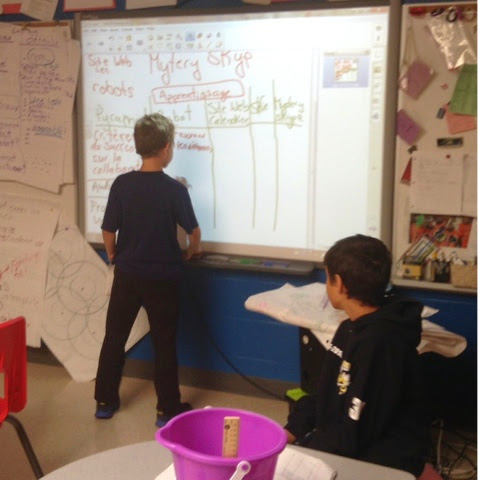
Some pictures of week two of students' experiences at learning.


What will be your students' learning experiences this coming week? We have lots ahead to revisit and reflect. I would love to hear about your experiences with your students!

Thank you for the feedback from last week's post and so exciting to have teachers try the sticky notes needs in class. As promised I will share our next steps. Students categorized the items and wrote questions about their needs since we are French language learners class. A group also took ownership of finding the cost of the items as we are learning to be a caring community . I had the students reflect on this video: 


With students' permission I am sharing a couple of projects on explaining:


A link to 30 hands about the Scribble Bot: 30 Hands Pro  Another video: Sharing learning